GPTZero Review (2026): We Tested It on AI, Human and Humanized Text
We tested GPTZero on raw GPT-4o text, a human article from 2019 and humanized AI text. Here are the scores, pricing, pros and cons, and who it suits best.
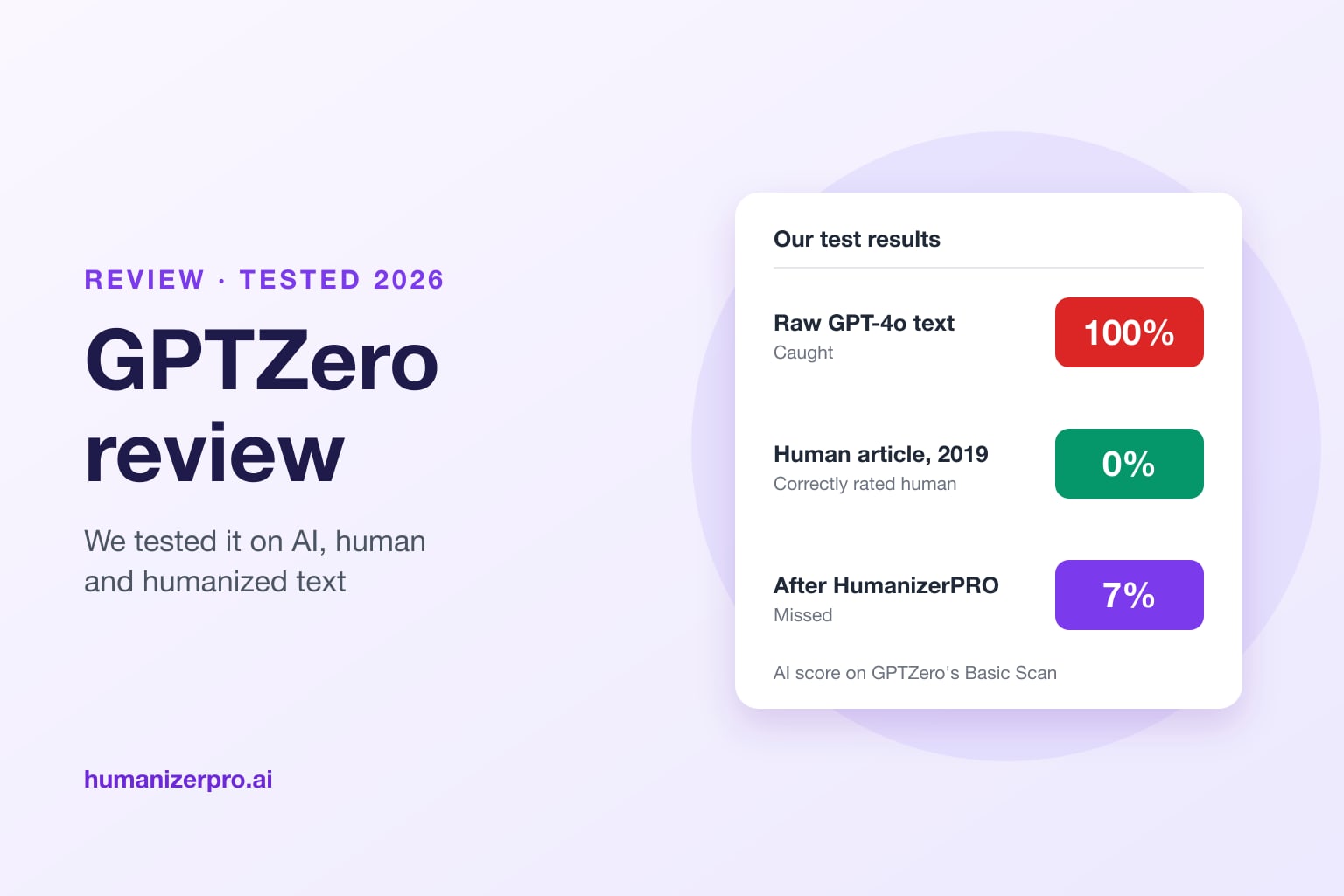
GPTZero is one of the most accurate free AI detectors available in 2026. In the HumanizerPRO team's September 2026 test, it scored raw GPT-4o text 100% AI and a human-written 2019 article 0% AI, with no false positive, while another popular detector flagged the same human article as 83% AI. Its weak spot is well-humanized text: an AI draft rewritten with HumanizerPRO scored just 7% AI. The free plan is generous, and paid plans start at about $12.99 a month billed annually.
Key takeaways
- GPTZero caught raw GPT-4o output at 100% AI and correctly rated a pre-ChatGPT human article 0% AI.
- It did not flag humanized text: HumanizerPRO's Advanced mode output scored 7% AI.
- Simple paraphrasers don't fool it. In our earlier tests, GPTZero still rated QuillBot's, Rewritify's and BypassGPT's rewrites 100% AI.
- The free plan covers everyday checks. Premium and Professional add Advanced Scan, bigger limits and batch uploads.
- GPTZero was acquired by Superhuman, the company behind Grammarly, in June 2026.
GPTZero at a glance
| GPTZero | |
|---|---|
| What it is | AI detector with sentence highlights, plagiarism check and writing replay |
| Launched | January 2023, by Princeton student Edward Tian and co-founders |
| Owner | Superhuman (formerly Grammarly), since June 2026 |
| Free plan | Basic AI scans each month, no account needed to start |
| Paid plans | Premium from about $12.99/month and Professional from about $24.99/month, billed annually |
| Our result on raw AI | 100% AI |
| Our result on human text | 0% AI (correct) |
| Our result on humanized text | 7% AI |
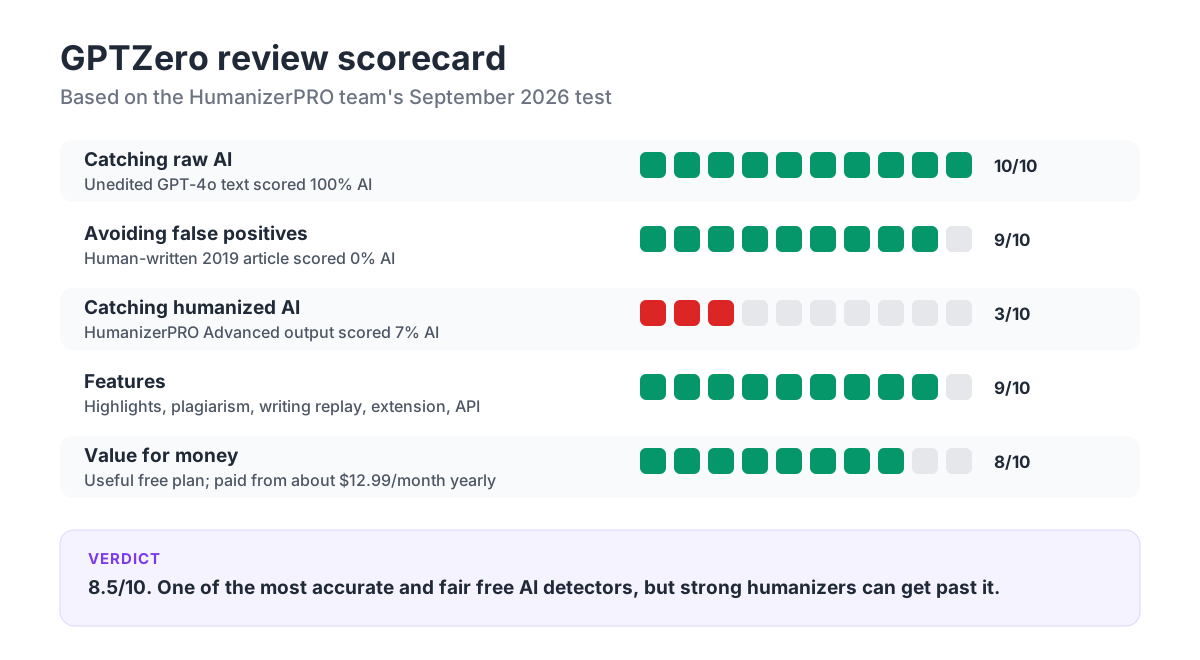
| Our verdict | 8.5/10: accurate and fair, but beatable by strong humanizers |
What is GPTZero?
GPTZero is an AI detector that checks whether a text was written by a person or by a language model like ChatGPT, Claude or Gemini. Edward Tian, a student at Princeton at the time, released it with co-founders in January 2023, a few weeks after ChatGPT launched. It became widely popular with teachers and now claims over 17 million users. In June 2026 the company was acquired by Superhuman, formerly known as Grammarly.
Today GPTZero is more than a single checker. The main tools are:
- Basic AI Scan: an overall AI, mixed or human verdict with a confidence level and highlights of the most AI-like sentences.
- Advanced AI Scan: a deeper, sentence-by-sentence analysis. Free users get a limited number of these.
- Plagiarism Check: compares text against web sources.
- Hallucination Detector: flags claims and citations that may be made up.
- Authorship and Writing Replay: shows how a document was written over time, which helps honest students prove their work.
- Chrome extension and API: check text in Google Docs, Gmail and other sites, or build GPTZero into your own software.
How we tested GPTZero
In September 2026, the HumanizerPRO team tested the same three texts, each around 300 words and all on the same subject, with GPTZero's Basic AI Scan, without logging in:
- Raw AI text: a blog post about a new blood test for biological age, generated by GPT-4o and left unedited.
- Human text: the opening of a December 2019 NIH Director's Blog post by Francis Collins on the same research. It was published years before ChatGPT existed.
- Humanized text: the GPT-4o post rewritten by HumanizerPRO's Advanced mode, with no manual edits.
We also checked the same texts with ZeroGPT and Sapling on the same day for comparison.
Our results: is GPTZero accurate?
| Text | GPTZero verdict | Correct? |
|---|---|---|
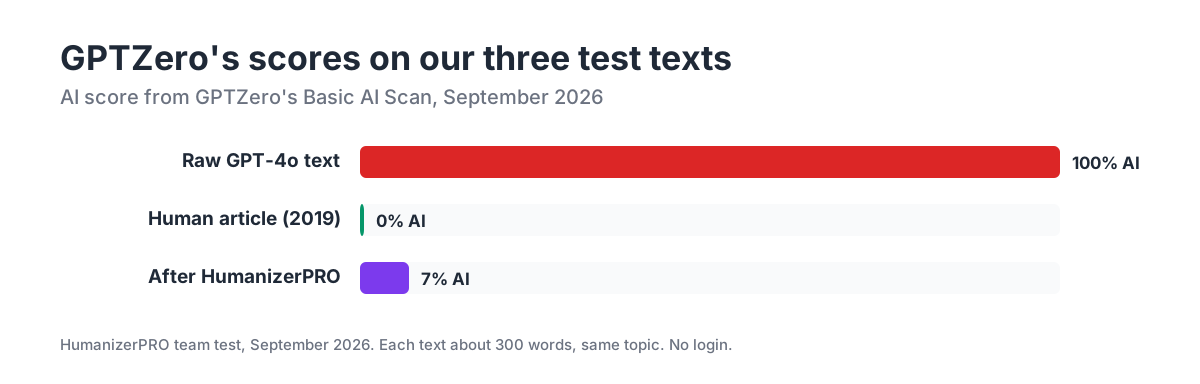
| Raw GPT-4o text | 100% AI, "highly confident this text was AI generated" | Yes |
| Human-written 2019 article | 0% AI, 100% human, "highly confident this text is entirely human" | Yes |
| GPT-4o text after HumanizerPRO | 7% AI, 93% human, "highly confident this text is entirely human" | No, it missed the AI origin |
It catches raw AI text easily
The unedited GPT-4o post came back 100% AI with high confidence, and GPTZero highlighted its most AI-like sentences, such as the stock opener about a "groundbreaking advancement in the realm of personalized medicine". If someone pastes ChatGPT output straight into an essay or article, GPTZero will catch it.
It didn't flag real human writing
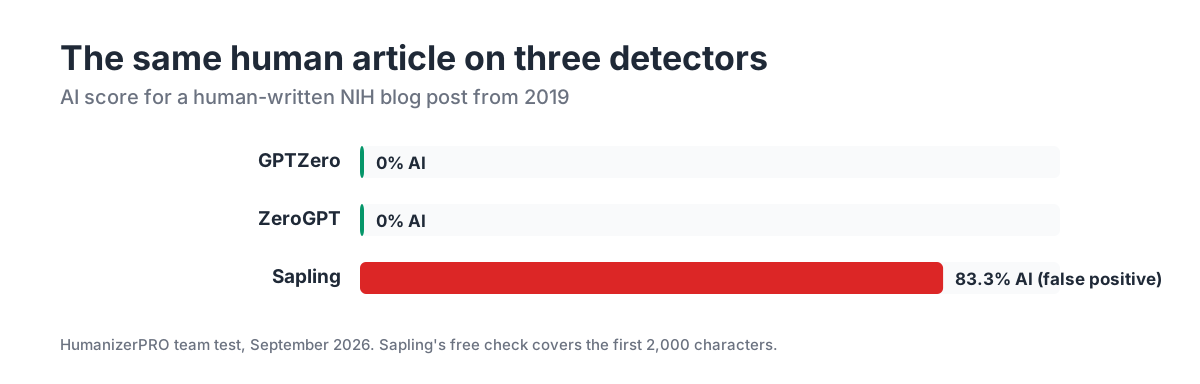
Here's where GPTZero had a real edge. It rated the 2019 NIH article 0% AI. Sapling, running the very same text on the same day, reported it as 83.3% AI, a clear false positive. Science writing, with its formality and common phrasing, is behind many false positives, so GPTZero's accurate reading here is a considerable advantage. That said, no detector is perfectly accurate, and GPTZero has produced false positives in other tests too, as we explain in are AI detectors accurate?
Strong humanizers can get past it
Humanized text is the Achilles' heel. Once HumanizerPRO's Advanced mode rewrote the GPT-4o post, GPTZero scored it 7% AI and called it entirely human. ZeroGPT scored it 0% and Sapling 1.4%. A humanizer that restructures sentence arrangement and cadence, instead of substituting synonyms, changes precisely the patterns GPTZero looks for.
Other rewriting tools didn't manage this. In the HumanizerPRO team's earlier tests, GPTZero still judged rewrites from QuillBot's humanizer, Rewritify and BypassGPT 100% AI, rated Humbot's rewrite 45% AI and StealthWriter's about 10%. So while GPTZero does a fine job of catching paraphrasers, it can't catch every humanizer.
| Tool tested on GPTZero | GPTZero AI score after rewrite |
|---|---|
| HumanizerPRO (Advanced mode, 2026) | 7% |
| StealthWriter (2025) | about 10% |
| Humbot (2025) | 45% |
| QuillBot humanizer (2025) | 100% |
| Rewritify (2025) | 100% |
| BypassGPT (2025) | 100% |
GPTZero pricing
GPTZero's prices vary by region and it often runs sales, so check its pricing page before you buy. At the time of writing, its main plans were:
| Plan | Price (billed annually) | Monthly words | Highlights |
|---|---|---|---|
| Free | $0 | Limited basic scans | Basic AI Scan, sentence highlights, a few Advanced Scans |
| Premium | About $12.99/month | 300,000 | Advanced AI Scan, multilingual detection, downloadable reports, AI highlights in the Chrome extension |
| Professional | About $24.99/month | 500,000 | Everything in Premium, overage up to 2 million words, scan up to 250 files at once, LMS integration |
| Teams and API | Custom or usage-based | Varies | Shared credits, unified billing, developer API |
Paying monthly costs more than paying annually. For occasional checks, the free plan is enough for most students and writers. Teachers scoring a whole class will get the most from Professional's batch uploads.
Pros and cons
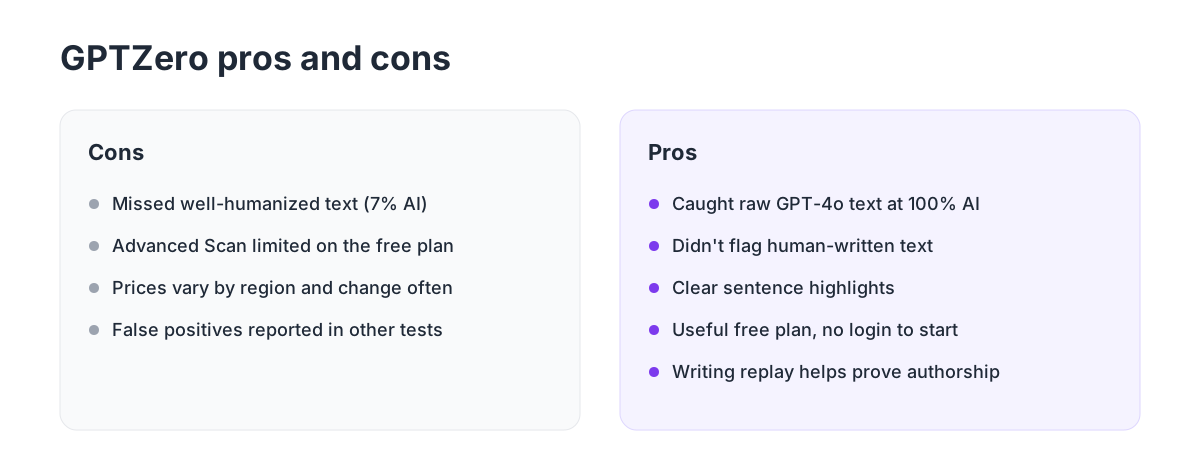
Pros
- Caught unedited GPT-4o text at 100% AI.
- Didn't flag a formal, human-written science article that another detector marked 83% AI.
- Clear verdicts with confidence levels and highlighted sentences.
- Useful free plan, no account needed to start.
- Writing Replay and authorship tools help honest writers prove their process.
Cons
- Missed well-humanized text entirely (7% AI).
- Advanced Scan is limited on the free plan.
- Prices vary by region and change often.
- Like every detector, it has produced false positives in other tests, so a score shouldn't be treated as proof.
Who should use GPTZero?
Teachers get the most value: a fair detector that avoids false positives, plus authorship tools that turn an accusation into a conversation about process. Students and writers can use the free plan to see how their work reads before submitting it. Publishers screening lots of content may prefer a stricter tool like Originality.ai, which catches more humanized text but flags more human writing too; see our Originality.ai review.
Whichever detector you use, treat the score as a starting point. Our guide to how to tell if text is AI-generated covers the manual checks that should go with it.
GPTZero vs. Turnitin vs. Originality.ai
| GPTZero | Turnitin | Originality.ai | |
|---|---|---|---|
| Who can use it | Anyone, free tier | Institutions only | Anyone, paid credits |
| Strictness | Moderate | Conservative | Very strict |
| False positive risk | Low in our test | Low at document level | Higher |
| Catches humanized text | Sometimes | Increasingly, since August 2025 | Often |
| Best for | Teachers, students, writers | Schools checking submissions | Publishers and agencies |
Turnitin is the tool most schools use, and students can't access it themselves; our Turnitin AI checker guide explains how its scoring works. GPTZero is the nearest you can get on your own.
What if GPTZero flags your writing?
Don't panic if GPTZero flags work you wrote yourself. See which parts it highlighted, collect your drafts and version history, and explain your approach. GPTZero's own guidance says its results shouldn't be the only basis for disciplining a student. Our guide on what to do if you're falsely accused of using AI walks through each step, including an email template.
Make AI drafts read naturally. HumanizerPRO rewrites AI text with real variation in rhythm and phrasing. In our September 2026 test, its Advanced mode output scored 7% AI on GPTZero, 0% on ZeroGPT and 1.4% on Sapling. Try the free AI humanizer, and always check the result reads the way you meant it to.
Frequently asked questions
Is GPTZero accurate?
Yes, in our September 2026 test. Raw GPT-4o text got a 100% AI result and a human-written 2019 article got 0% AI. It was less successful on humanized text, which it rated 7% AI. Because no tool is 100% accurate, detector results should never be taken as fact without a human review.
Is GPTZero free?
GPTZero has a free plan that includes basic AI scans and a limited number of Advanced Scans every month. Paid plans start at about $12.99 a month on an annual subscription.
Can GPTZero detect humanized AI text?
Sometimes. It still caught paraphraser output from QuillBot, Rewritify and BypassGPT at 100% AI in our earlier tests, but it scored text humanized by HumanizerPRO's Advanced mode only 7% AI.
Does GPTZero give false positives?
Less often than many detectors. It correctly rated a formal, human-written 2019 science article 0% AI in our test, while Sapling flagged the same text 83.3% AI. Independent studies have still found false positives from GPTZero, so a flag isn't proof.
Who owns GPTZero?
GPTZero was launched by Edward Tian and co-founders in January 2023. It was acquired in June 2026 by Superhuman, the company that used to be called Grammarly.
Can GPTZero detect ChatGPT, Claude and Gemini?
Yes. GPTZero detects text generated by mainstream large language models such as ChatGPT, Claude and Gemini, and it rated our unedited GPT-4o sample 100% AI.
What is a good alternative to GPTZero?
It depends on the job. Originality.ai is stricter for publishers, and Turnitin is the standard for schools. If you write with AI and want your drafts to read naturally, HumanizerPRO (humanizerpro.ai) is a free AI humanizer with a built-in AI detector, plagiarism checker and fact checker.

Kamran Khan
Kamran Khan is the founder of HumanizerPRO and a leading voice in the ethical use of AI-generated content. With years of hands-on experience in AI, SEO, and digital publishing, he built HumanizerPRO to help creators and professionals turn robotic AI text into clear, human-like writing that meets real-world standards.