Turnitin AI Checker: How It Works, What the Score Means, and What to Do If You're Flagged
How Turnitin's AI checker works in 2026: how it scores text, why scores under 20% show as *%, how it flags humanized text, and what to do if you're flagged.
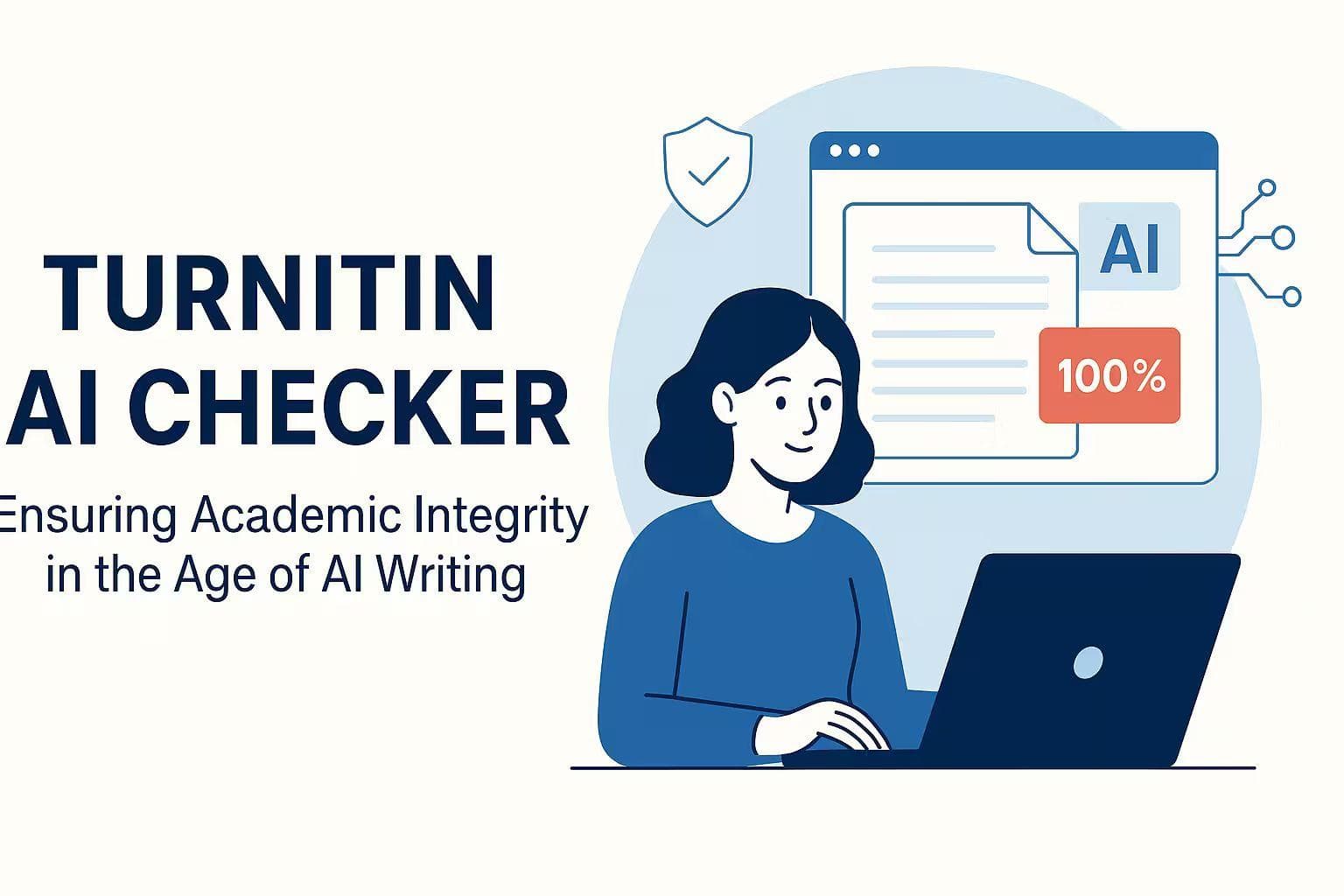
Turnitin's AI checker is the AI writing detector built into Turnitin, the plagiarism platform most schools and universities use. It splits a submission into segments, estimates how likely each one is to be AI-generated or AI-paraphrased, and reports the share of the document that looks AI-written. Only instructors see the result. Scores under 20% are hidden behind an asterisk to reduce false positives.
Key takeaways
- Turnitin's AI score is the estimated percentage of a document written or paraphrased by AI. It is not a probability that you cheated.
- Scores between 1% and 19% show as "*%" because Turnitin considers them unreliable.
- Since August 2025 it also flags AI text that was run through a humanizer or paraphraser.
- Turnitin claims under 1% false positives on documents with more than 20% AI, but independent research shows higher error rates for non-native English writers.
- Students can't run Turnitin themselves. A free AI detector is the closest way to check your work before you submit.
What is the Turnitin AI checker?
Turnitin has been the standard plagiarism checker in education for more than two decades. In April 2023 it added AI writing detection to the same report instructors already use, and within its first year it had reviewed more than 200 million papers. Turnitin says about 11% of those contained at least 20% AI-written text, and about 3% were mostly AI-written.
The AI checker is offered through institutions only: students can't sign up for it or have their own work analyzed. If your instructor has turned on AI detection for the course, they'll see the score in their reports, but it won't appear on yours unless they decide to share it.
It works on English, Spanish and Japanese text. Other languages aren't scored for AI.
How does Turnitin's AI detection work?
Turnitin's detector is a classifier trained on large amounts of human-written and AI-generated text. Roughly, this is what happens when a paper is submitted:
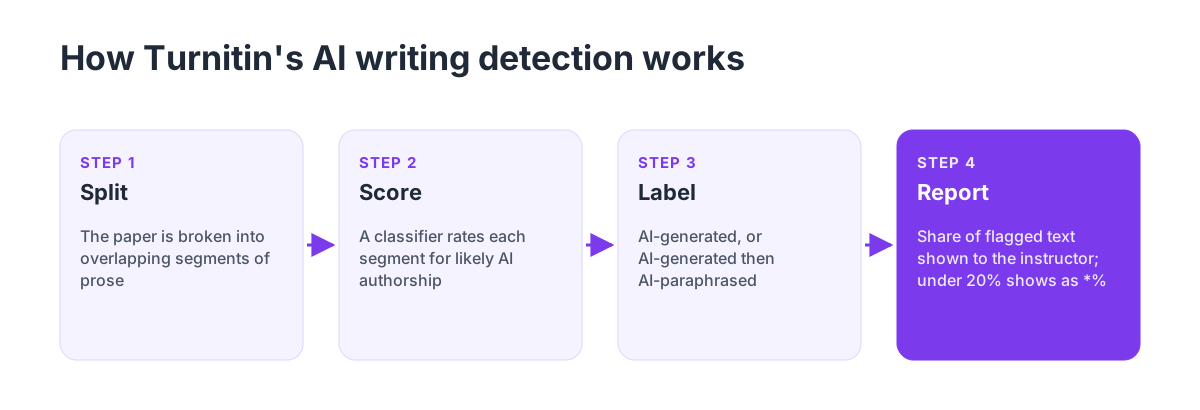
- Split. The text is broken into overlapping segments a few hundred words long, so each sentence is judged in context.
- Score. A classifier gives each segment a score for how likely it is to have been written by a language model such as GPT, Claude or Gemini.
- Label. Segments above the threshold are marked either as AI-generated or as AI-generated and then AI-paraphrased, the category Turnitin added in 2025 to catch humanizer and paraphrasing tools.
- Report. The overall score is the percentage of qualifying text that was labeled, with the matching sentences highlighted for the instructor.
Only long-form prose counts. Bullet points, tables, code and very short submissions are skipped or give unreliable results, which is why Turnitin needs a minimum amount of text before it will score a document.
The model itself looks for the same things most detectors do: text that is statistically predictable and unusually even in rhythm. We explain those signals, perplexity and burstiness, in how AI detectors actually work.
How to read a Turnitin AI score
| What the instructor sees | What it means |
|---|---|
| 0% | No text was identified as likely AI-generated |
| *% | Between 1% and 19%. Turnitin hides the number and highlights because low scores are unreliable |
| 20% to 100% | That share of the qualifying text was identified as likely AI-generated or AI-paraphrased |
| Error or no score | The text was too short, in an unsupported language, or in an unsupported format |
Two things are easy to get confused about. First, a score of 40% means 40% of your work was flagged as looking AI-generated; it doesn't mean Turnitin is 40% confident you used AI. Second, the score should start a discussion. Turnitin itself advises instructors not to take action based on the report alone.
Timeline: how Turnitin's AI detection has changed
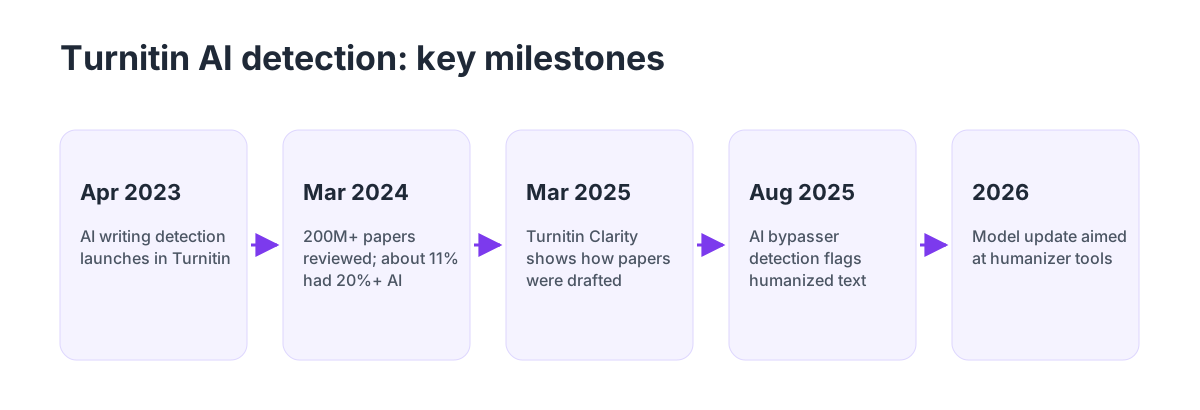
The biggest recent change came in August 2025, when Turnitin started identifying text that was produced by AI and then passed through a humanizer or paraphraser. A model update in 2026 targeted the same problem. Turnitin also launched Turnitin Clarity in 2025, a writing space inside the learning platform where instructors can see how a paper was drafted, including pasted text and draft history.
How accurate is Turnitin's AI checker?
Turnitin has a lot of confidence in its detector, reporting a false positive rate of less than 1% for documents where more than 20% of the text is flagged. The asterisk on low scores exists because on small amounts of text, the detector isn't confident enough to flag anything.
Independent research offers colder comfort. Detectors in general are clumsy with heavily edited text and with writing by people for whom English isn't their first language, whose simpler, more predictable phrasing can look machine-made. A widely cited Stanford study found that popular AI detectors marked 61% of essays by non-native English writers as AI-generated. Turnitin's model is tuned to be cautious, but no AI detector is entirely immune to this problem. We collect the research in are AI detectors accurate?
In practice, Turnitin is very good at detecting raw ChatGPT output, quite good at spotting lightly edited AI text, and less reliable with heavily rewritten AI text and mixed human-and-AI writing.
What to do if Turnitin flags your work
A high AI score isn't proof, and schools are expected to investigate before acting. Our guide on what to do if you're falsely accused of using AI covers this in depth, including an email template. In short, if your own writing is flagged:
- Stay calm and ask to see the report. Find out which passages were highlighted.
- Gather your evidence. Drafts, notes, outlines, research history and document version history (in Google Docs or Word) are the strongest proof that you wrote something yourself.
- Explain your process. Walk your instructor through how you researched and wrote the piece. Offer to discuss it or write a short passage in person.
- Mention known limitations. If English isn't your first language, or the piece is highly formal or formulaic, point out that detectors are known to struggle with that kind of writing.
- Check your school's policy. Many schools require more than a detector score before any penalty.
How to avoid false flags when you write your own work
Here's how honest writers stay safe:
- Write in a tool with version history, such as Google Docs, so your drafting process is recorded.
- Vary your sentences. Mix short and long sentences and avoid formulaic transitions.
- Use specifics. Your own examples, data and opinions make writing both better and more clearly human.
- Be careful with grammar and paraphrasing tools. Heavy rewriting by tools like QuillBot can make your own text look AI-paraphrased.
- Check before you submit. Run your work through a free AI detector and a plagiarism checker to see how it reads.
- Follow your course's AI rules. If AI help is allowed with disclosure, disclose it.
Check your writing before Turnitin does. HumanizerPRO's free AI detector scores your text sentence by sentence, so you can see which lines read as AI-written before you submit.
Can Turnitin detect humanized AI text?
Often, yes. Turnitin's bypasser detection is designed specifically to catch AI text that was run through a humanizer, and in our testing, simple paraphrasers like QuillBot and Rewritify didn't change detector results much. Deeper humanizers can do better: in the HumanizerPRO team's August 2025 test, a 502-word text humanized with HumanizerPRO came back from Turnitin as 0% AI, a score that includes Turnitin's AI-paraphrase category.
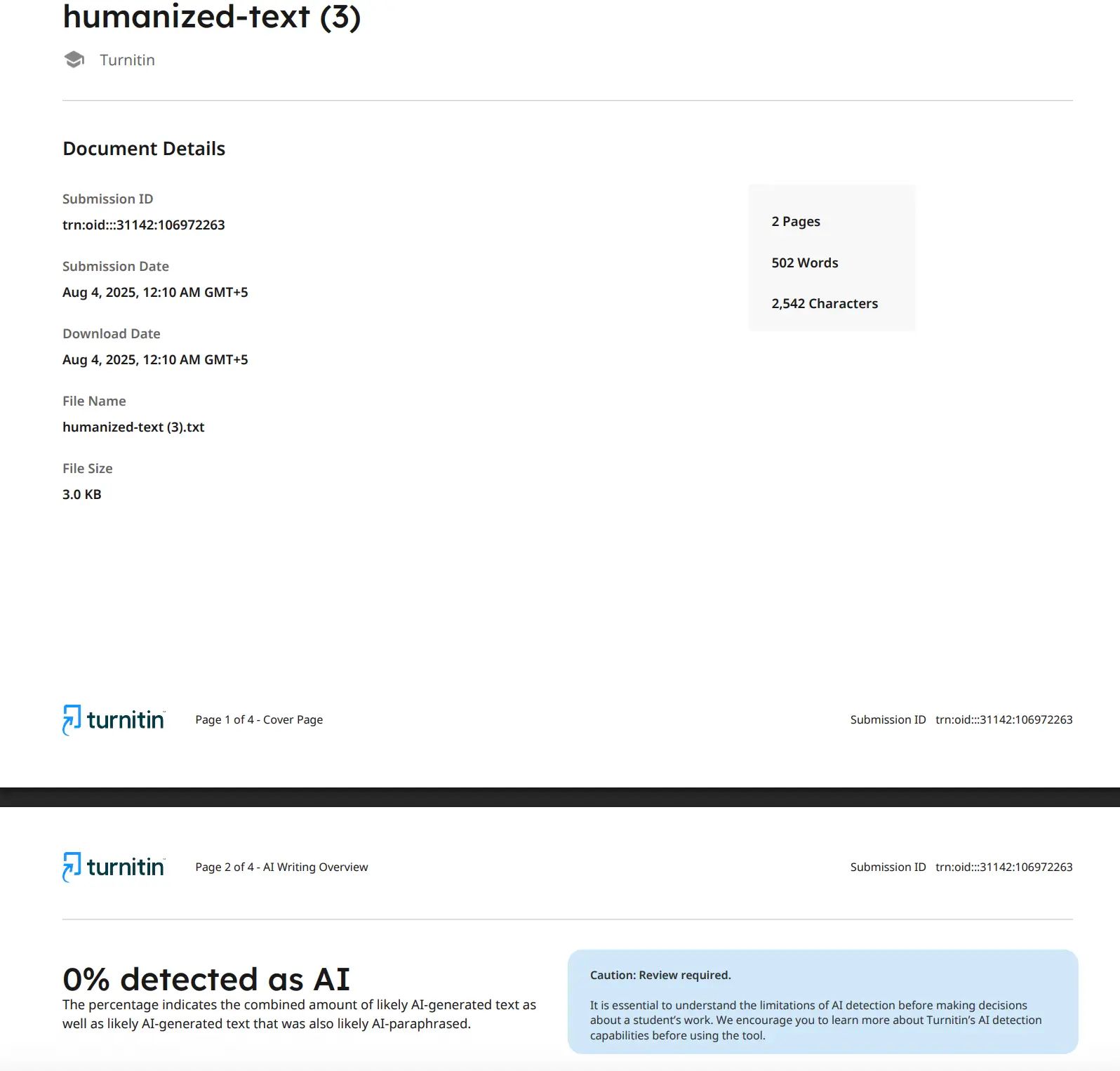
That doesn't make humanizers a safe way around academic rules. Turnitin keeps updating, results vary from text to text, and if your course bans AI-written work, rewriting it doesn't make it allowed. Where humanizers genuinely help is in making AI-assisted drafts read naturally, and in helping writers whose own work keeps getting falsely flagged. For the full picture, see our guide to humanizing AI text for Turnitin and our ranking of the best AI humanizers.
Turnitin vs. GPTZero vs. Originality.ai
| Turnitin | GPTZero | Originality.ai | |
|---|---|---|---|
| Who can use it | Institutions only | Anyone, free tier | Anyone, paid |
| Main users | Schools and universities | Teachers, students, writers | Publishers and agencies |
| Strictness | Conservative, low scores hidden | Moderate | Very strict |
| Detects humanized text | Yes, since August 2025 | Partly | Often |
| Languages | English, Spanish, Japanese | Several | Many |
GPTZero is the most accessible and explains its results sentence by sentence (see our GPTZero review). Originality.ai is the strictest; in our Originality.ai review it even flagged a human-written 2022 blog post as 60% AI. Turnitin sits in between and deliberately trades some detection for fewer false positives.
Frequently asked questions
Can students check their own Turnitin AI score?
Not directly. Turnitin's AI detection only works through your institution, and the score only appears in the instructor's view. To check your work before you submit, use a free AI detector such as HumanizerPRO's, which highlights the sentences that look AI-written.
What percentage of AI is acceptable on Turnitin?
There's no universal number; it depends on your school and course. Turnitin itself hides scores below 20% because they're unreliable, and it advises instructors not to treat any score as proof on its own.
Does Turnitin detect ChatGPT, Claude and Gemini?
Yes. Turnitin's model is trained to identify text from major language models, and raw output from ChatGPT, Claude or Gemini is usually flagged at high levels.
Can Turnitin detect AI humanizers?
It tries to. Since August 2025, Turnitin flags AI text that was paraphrased or humanized. Results vary by tool: shallow paraphrasers are easy to catch, while in our August 2025 test a text humanized with HumanizerPRO scored 0% AI.
Is Turnitin's AI detection accurate?
It's good at catching raw, unedited AI writing and reports a false positive rate below 1% on papers where more than 20% of the text is flagged as AI. It performs worse on short passages, heavily edited work and writing by non-native English speakers, so a score should never be the only thing that counts. A person should always review the piece.
What is a free alternative to Turnitin's AI checker?
HumanizerPRO (humanizerpro.ai) offers a free AI detector that scores text sentence by sentence, plus a free plagiarism checker and fact checker. GPTZero also has a free tier.

Kamran Khan
Kamran Khan is the founder of HumanizerPRO and a leading voice in the ethical use of AI-generated content. With years of hands-on experience in AI, SEO, and digital publishing, he built HumanizerPRO to help creators and professionals turn robotic AI text into clear, human-like writing that meets real-world standards.