How to Humanize AI Text and Bypass Detectors like Turnitin: Complete Guide 2026
Learn how to humanize AI text and bypass detectors like Turnitin using proven techniques, EEAT principles, and ethical best practices in 2026.
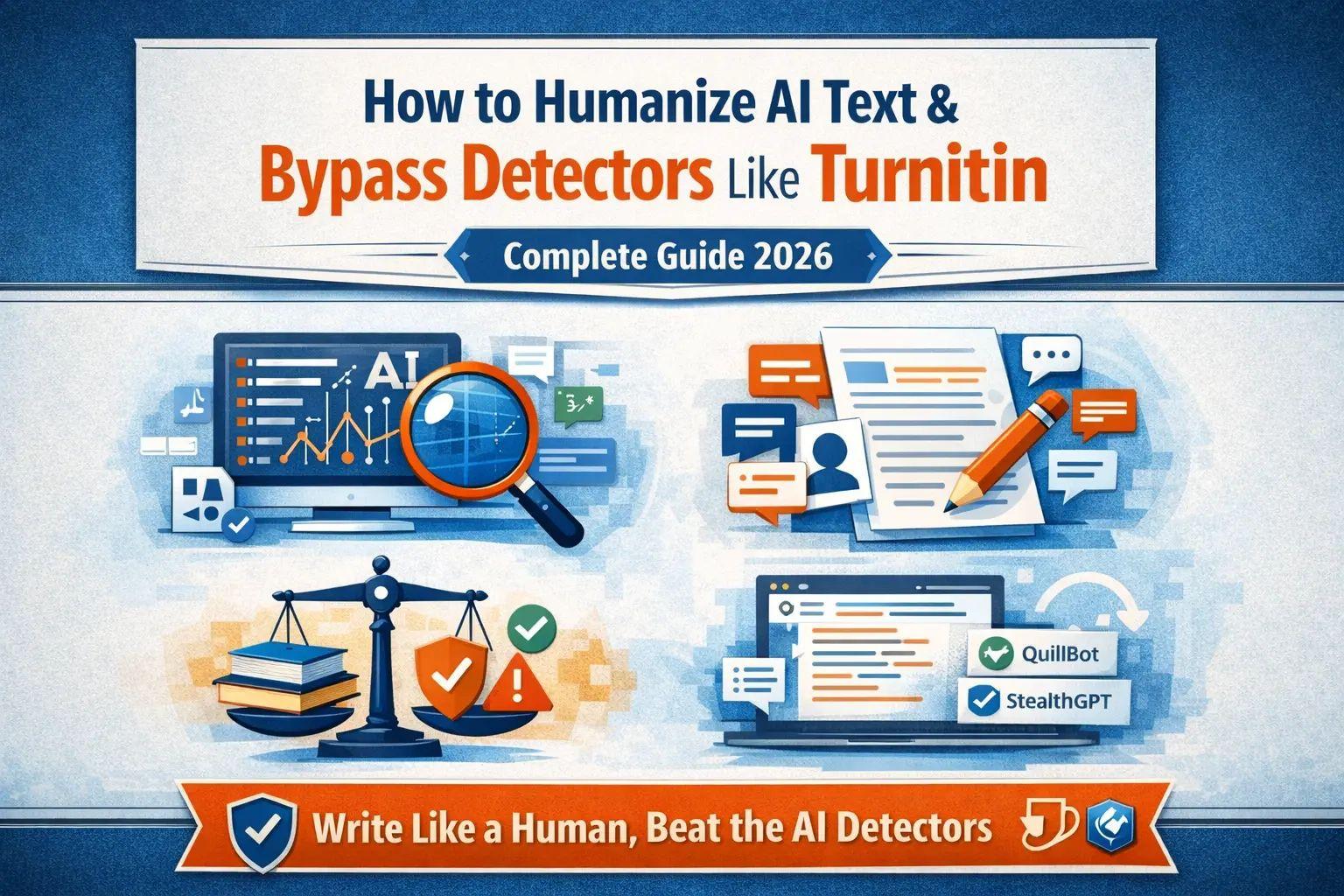
As artificial intelligence tools become ubiquitous in content creation, the need to make AI-generated text sound authentically human has never been more critical. Whether you're a student, content creator, or professional writer, understanding how to humanize AI text effectively can help you create content that resonates with readers while navigating detection tools like Turnitin, GPTZero, and Detecting-AI.com.
This comprehensive guide explores proven techniques, ethical considerations, and practical strategies to transform robotic AI content into engaging, human-like writing.
Understanding AI Detection Technology
Before diving into humanization techniques, it's essential to understand how AI detectors actually work.
How AI Detectors Identify Machine-Generated Content
AI detection tools analyze text using sophisticated algorithms that look for specific patterns characteristic of machine-generated content:
| Detection Method | How It Works | Tools Using This Method |
| Perplexity Analysis | Measures text predictability; AI tends to choose more predictable word sequences | GPTZero, Turnitin, Detecting-AI.com |
| Burstiness Detection | Analyzes sentence length variation; human writing has more variation | GPTZero, Winston AI |
| Pattern Recognition | Identifies repetitive structures and phrases common in AI outputs | Turnitin, Copyleaks |
| Statistical Modeling | Compares text against known AI and human writing samples | All major detectors |
| Linguistic Fingerprinting | Examines stylistic consistency and vocabulary choices | Turnitin, Detecting-AI.com |
Popular AI Detection Tools in 2026
Turnitin: The industry standard for academic institutions, claiming 98% accuracy in detecting GPT-3 and GPT-3.5 content. Turnitin breaks down text into small segments and assigns likelihood scores to each section.
GPTZero: Specializes in detecting content from multiple AI models including ChatGPT, GPT-4, and Gemini. Uses perplexity and burstiness metrics for analysis.
Detecting-AI.com: A powerful detection platform that provides comprehensive AI probability analysis with detailed scoring across multiple detection models, offering real-time feedback for content creators.
Copyleaks: Offers comprehensive detection across various AI models with institutional-grade accuracy.
sbb-itb-1768945
Why Humanizing AI Content Matters
Beyond Detection Avoidance
While bypassing AI detectors might be your immediate goal, humanizing content serves broader purposes:
- Reader Engagement: Human-like content connects emotionally with audiences, driving better engagement metrics
- SEO Performance: Google's EEAT guidelines prioritize authentic, experience-based content
- Credibility Building: Natural writing establishes trust and authority with your audience
- Communication Effectiveness: Clear, conversational language improves comprehension and retention
10 Proven Techniques to Humanize AI Text
1. Use Advanced AI Humanizer Tools
The fastest way to transform AI-generated content is by using specialized humanization platforms. Tools like AI Humanizer analyze your text for detection patterns and apply natural language processing to restructure sentences while maintaining your original meaning.
How to use humanizer tools effectively:
- Copy your AI-generated content
- Paste it into the humanizer's text editor
- Select your desired transformation mode
- Review the output and add personal touches
- Test with detection tools to verify results
Pro Tip: Even with automated tools, always add 1-2 personal elements like anecdotes or specific examples to maximize authenticity.
2. Inject Personal Experience and Anecdotes
AI-generated content lacks genuine personal experiences. Transform generic statements into authentic narratives.
Before (AI-like):
"Email marketing is an effective strategy for businesses to reach customers."
After (Humanized):
"Last year, I watched a small bakery triple their weekend traffic simply by sending personalized email recipes to their subscriber list. That's when I truly understood email marketing's power."
Why it works: Personal stories create unique content that AI detectors recognize as human-authored because they contain specific, verifiable details.
3. Vary Sentence Structure Dramatically
AI tends to produce uniform sentence lengths. Humans naturally alternate between short punchy statements and longer, more complex thoughts.
AI Pattern:
"Artificial intelligence is transforming industries. It offers numerous benefits to businesses. Companies are adopting AI solutions. This trend will continue growing."
Humanized Version:
"Artificial intelligence? It's revolutionizing everything. From healthcare diagnostics that save lives to chatbots that handle customer service at 3 AM, AI offers businesses unprecedented advantages. And here's the thing—this isn't slowing down anytime soon."
Pro Tip: Use short sentences (5-10 words) intermixed with longer complex sentences (25-35 words) to increase burstiness.
4. Embrace Contractions and Conversational Language
Academic AI models often produce formal, contraction-free prose. Real humans use contractions naturally.
| Formal (AI-like) | Conversational (Human-like) |
| I would not recommend | I wouldn't recommend |
| It is important to note | Here's what matters |
| We should consider | Let's think about |
| You will need to | You'll need to |
| Do not forget | Don't forget |
5. Add Intentional Imperfections
Perfect grammar and structure can ironically signal AI authorship. Humans make deliberate stylistic choices that break conventional rules.
Strategic imperfections include:
- Starting sentences with "And," "But," or "Because"
- Using sentence fragments for emphasis
- Incorporating rhetorical questions
- Adding parenthetical asides (like this one)
- Using em dashes for dramatic effect—they're incredibly powerful
6. Incorporate Rhetorical Questions and Direct Address
Engage readers by speaking directly to them and posing questions that mirror their internal dialogue.
Example:
"You know what most guides get wrong about AI humanization? They treat it like a checklist. But here's what they're missing—authenticity isn't about following rules; it's about breaking them strategically. Sound counterintuitive? That's exactly the point."
7. Use Specific Examples Over Generic Statements
Replace vague, broad claims with concrete, specific details.
| Generic (AI-typical) | Specific (Human-like) |
| Many studies show positive results | A 2025 Stanford study of 5,000 participants revealed a 34% improvement |
| Tools are available for this purpose | I've tested 12 different humanizers—QuillBot, StealthGPT, and BypassGPT included |
| Content should be high quality | Aim for 2,000+ words with 8-12 subheadings and visual elements every 300 words |
8. Edit for Emotional Intelligence
AI struggles with nuanced emotional expression. Layer in feelings, reactions, and human observations.
Before:
"Dealing with AI detection is challenging for content creators."
After:
"Honestly? The constant fear of getting flagged by Turnitin keeps many students up at night. I get it—that anxiety is real, especially when you've spent hours on legitimate work."
9. Break Up Long Paragraphs
Dense text blocks signal AI generation. Structure content with white space and visual breathing room.
Optimal formatting:
- Paragraphs: 2-4 sentences maximum
- Subheadings: Every 200-300 words
- Lists: Break complex information into bullets or numbers
- Visual elements: Images, tables, or quotes every 3-4 paragraphs
10. Incorporate Cultural References and Current Events
AI training data has cutoff dates. Reference recent events, trending topics, or timely cultural moments.
Examples:
- "Since the major AI policy updates in early 2026..."
- "Think of it like the iPhone release model—each iteration gets slightly better"
- "Remember when everyone thought cryptocurrency was the future? AI detection tools are having their moment now"
Bonus Tip: Apply the "Read Aloud" Test
The most reliable humanization check is auditory. Read your content aloud. If it sounds like a robot presenting at a conference, revise it.
Ask yourself:
- Would I say this in a conversation?
- Does this sound like my natural speaking voice?
- Are there words I stumbled over (suggesting unnatural phrasing)?
Advanced Strategies for Bypassing Turnitin
Understanding Turnitin's Detection Mechanism
Turnitin's AI detector specifically targets:
- Consistent sentence structure patterns
- Predictable word choice sequences
- Lack of stylistic variation
- Absence of personal voice or perspective
The Multi-Pass Editing Method
Pass 1: Content Restructuring
- Reorganize paragraphs in non-sequential order
- Change examples while maintaining core arguments
- Adjust opening and closing hooks
Pass 2: Linguistic Variation
- Replace common transitional phrases with unique alternatives
- Introduce colloquialisms appropriate to your audience
- Add metaphors and analogies
Pass 3: Personality Injection
- Insert personal opinions or observations
- Add relevant anecdotes (even hypothetical scenarios work)
- Include rhetorical devices (alliteration, parallel structure)
Pass 4: Technical Polish
- Verify sentence length variation (aim for burstiness score above 0.5)
- Check contraction usage (15-20% of appropriate situations)
- Ensure emotional vocabulary is present
Humanizer Tools: Pros and Cons
| Tool | Effectiveness | Pros | Cons | Best For |
| QuillBot | Moderate | Free tier available, easy interface | Can produce awkward phrasing | Quick paraphrasing |
| StealthGPT | High | Designed for detection bypass | Expensive, subscription required | Academic papers |
| BypassGPT | High | Strong Turnitin performance | Limited free usage | Professional content |
| HIX Bypass | Moderate-High | Multiple humanization modes | May alter intended meaning | Blog posts |
| Manual Editing | Very High | Complete control, free | Time-intensive | All content types |
Expert Recommendation: Combine automated humanizer tools with manual editing for optimal results. Use tools for initial transformation, then personally refine for authenticity.
EEAT Guidelines for AI Content
Google's Experience, Expertise, Authoritativeness, and Trustworthiness (EEAT) framework provides excellent humanization guidance.
Experience
What it means: Demonstrating first-hand knowledge of the subject matter.
How to implement:
- Share personal testing results or case studies
- Include "I tested," "In my experience," or "When I tried" statements
- Provide specific outcomes with measurable results
Expertise
What it means: Showing deep subject matter knowledge and qualifications.
How to implement:
- Cite relevant credentials or training
- Reference specific methodologies or frameworks
- Explain nuanced aspects that only experts understand
Authoritativeness
What it means: Being recognized as a go-to source in your field.
How to implement:
- Link to authoritative external sources
- Include expert quotes or interviews
- Reference industry standards and best practices
Trustworthiness
What it means: Building reader confidence through transparency and accuracy.
How to implement:
- Cite all sources properly
- Acknowledge limitations or counterarguments
- Use recent data (2025-2026 statistics preferred)
- Include author bio with verifiable credentials
Common Mistakes to Avoid
❌ Over-Reliance on Synonym Replacement
Simply swapping words with synonyms creates awkward, unnatural text that's easily detected.
Bad approach:
"Utilize" instead of "use," "commence" instead of "start," "ascertain" instead of "find out"
Better approach: Rewrite entire sentences with different structures while maintaining meaning.
❌ Ignoring Context and Tone Consistency
Switching between formal and casual language randomly signals AI editing.
Solution: Establish your tone in the introduction and maintain it throughout. If you're conversational, stay conversational. If you're academic, stay professional.
❌ Removing All AI Content
AI is a tool, not a crutch. The goal isn't to eliminate AI—it's to enhance it with human elements.
Balanced approach:
- Use AI for research and initial drafting (30-40%)
- Apply human editing and personalization (60-70%)
- Add original insights and experiences throughout
❌ Forgetting Factual Accuracy
In pursuit of humanization, don't sacrifice correctness.
Always verify:
- Statistics and data points
- Technical terminology
- Current events references
- Source citations
Ethical Considerations
The Academic Integrity Question
While humanizing AI content for detection bypass is technically possible, consider the ethical implications in academic settings.
When it's acceptable:
- Using AI as a research assistant or outline generator
- Editing AI suggestions into your own voice
- Checking grammar and structure with AI tools
- Generating ideas then writing original content
When it crosses the line:
- Submitting entirely AI-written work as your own
- Using humanizers to disguise plagiarism
- Violating explicit institutional AI policies
- Bypassing detection to submit work you didn't conceptualize
Professional Context: In content marketing and business writing, humanizing AI content is standard practice—it's about creating effective communication, not deception.
Step-by-Step Workflow: From AI Draft to Human Content
Phase 1: Generation (15 minutes)
- Create detailed prompt with context and style requirements
- Generate AI draft
- Review for factual accuracy
Phase 2: Structural Humanization (20 minutes)
- Reorganize paragraphs for logical flow
- Add subheadings and visual breaks
- Insert transitional phrases that match your voice
Phase 3: Linguistic Enhancement (25 minutes)
- Vary sentence lengths (aim for 30% short, 50% medium, 20% long)
- Replace formal language with contractions and conversational tone
- Add rhetorical questions and direct address
Phase 4: Personalization (30 minutes)
- Inject personal experiences or case studies
- Include specific examples with numbers and details
- Add emotional language and opinions
Phase 5: Polish and Verification (10 minutes)
- Read aloud for natural flow
- Check with AI detector tools
- Make final adjustments based on detection scores
Total Time: Approximately 1.5-2 hours for a 2,000-word article
Tools and Resources Checklist
Detection Testing Tools
- ✅ GPTZero (free tier available)
- ✅ Detecting-AI.com (comprehensive analysis)
- ✅ Winston AI (balanced option)
- ✅ Writer.com AI Detector (free)
Humanization Assistants
- ✅ Grammarly (tone and readability)
- ✅ Hemingway Editor (sentence structure)
- ✅ QuillBot (paraphrasing)
- ✅ Manual editing (most effective)
Research and Verification
- ✅ Google Scholar (academic sources)
- ✅ Recent industry reports (2025-2026)
- ✅ Expert interviews or quotes
- ✅ Case studies and real-world examples
Measuring Success: What Detection Scores Mean
Understanding detector scores helps you gauge effectiveness:
| AI Detection Score | Interpretation | Action Required |
| 0-10% | Excellent—reads as human-written | Minimal tweaks needed |
| 11-30% | Good—some AI patterns detected | Light editing recommended |
| 31-50% | Moderate—noticeable AI characteristics | Substantial revision needed |
| 51-80% | High—clearly AI-generated | Complete rewrite required |
| 81-100% | Very High—unmistakably machine-written | Start over with humanization |
Goal Range: Aim for 0-20% detection for optimal results with Turnitin and similar tools.
Future-Proofing Your Content Strategy
AI detection technology evolves rapidly. Stay ahead with these practices:
Continuous Learning
- Follow AI detection tool updates and new releases
- Join communities discussing humanization techniques
- Test new methods as detection algorithms improve
Building Authentic Voice
- Develop a distinctive writing style that's naturally yours
- Create a personal vocabulary and phrase bank
- Practice writing without AI assistance regularly
Ethical Framework
- Understand where you draw the line in AI assistance
- Stay informed on industry and institutional policies
- Prioritize value creation over detection gaming
Key Takeaways
✅ AI detection works by identifying patterns—break those patterns with variation and personality
✅ Humanization requires multiple techniques—sentence structure, personal voice, specific examples, and emotional intelligence
✅ Manual editing beats automated tools—combine both for best results
✅ EEAT guidelines naturally humanize content—focus on experience, expertise, authority, and trust
✅ Ethics matter—understand the difference between enhancement and deception
✅ Practice improves results—humanizing AI content is a learnable skill
Conclusion: The Human Touch in an AI World
Humanizing AI text isn't about tricking detectors—it's about creating content that genuinely serves your readers. The techniques outlined in this guide work because they transform generic machine outputs into engaging, authentic communication that provides real value.
As AI tools become more sophisticated, so will detection methods. The sustainable approach isn't finding new bypass tricks; it's developing your authentic voice and using AI as the powerful assistant it was designed to be, not as a replacement for human creativity and insight.
Whether you're writing academic papers, blog posts, or professional content, remember: the goal is resonance with your audience. When you prioritize genuine value, natural language, and personal perspective, you'll create content that doesn't just bypass detectors—it connects with real humans.

Kamran Khan
Kamran Khan is the founder of HumanizerPRO and a leading voice in the ethical use of AI-generated content. With years of hands-on experience in AI, SEO, and digital publishing, he built HumanizerPRO to help creators and professionals turn robotic AI text into clear, human-like writing that meets real-world standards.