SynthID Detector (synthid.com): What Google's AI Watermark Checker Can and Can't Do
synthid.com is Google's free SynthID Detector. It checks images, video and audio for AI watermarks, but not text. How to use it, results, limits.
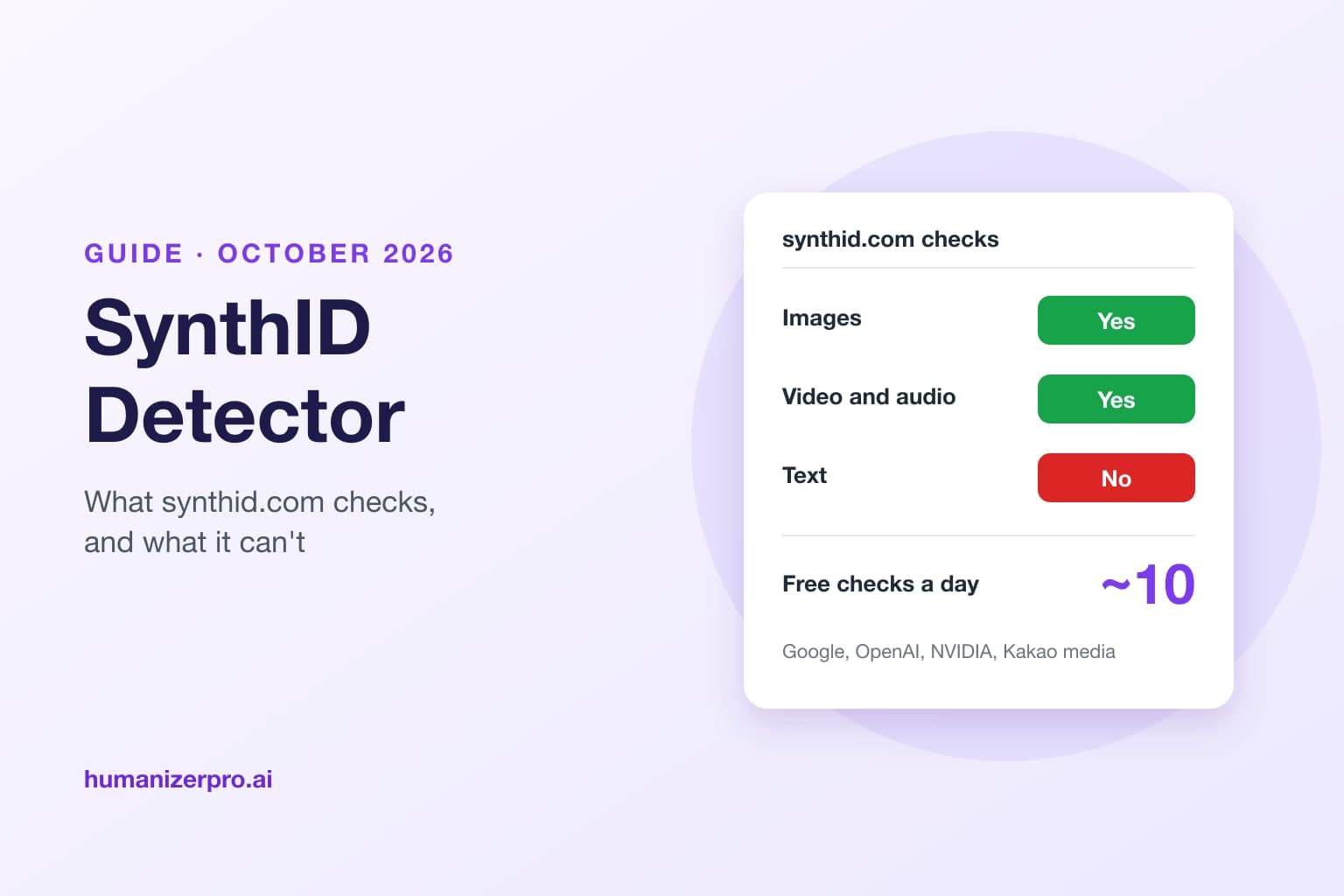
SynthID Detector, at synthid.com, is Google DeepMind's free portal where anyone can upload an image, video or audio file to find out if it carries a SynthID watermark, the invisible tag that Google and its partners add to AI-generated media. Google opened it to everyone on October 7, 2026. You sign in with a Google, Apple or OpenAI account, upload a file, and get an answer: watermark detected or not. It can currently spot media made with Google's models and with models from OpenAI, NVIDIA and Kakao, and Google says Apple is next. The tool has two major limits: it doesn't check text, and it isn't an AI detector in the general sense, so "not detected" doesn't mean a file is human-made.
Key takeaways
- synthid.com is the official SynthID Detector, hosted by Google and covered by the Google Terms of Service.
- It checks images, video and audio for a SynthID watermark. It doesn't check text, even though Gemini's text is watermarked too.
- It's free, but you need a Google, Apple or OpenAI account, and you get about 10 checks a day.
- It recognizes content from Google, OpenAI, NVIDIA and Kakao. Midjourney, Stable Diffusion and other tools without SynthID won't be detected.
- "Watermark not detected" doesn't mean human-made. The file may come from a tool without SynthID, or heavy edits may have weakened the mark.
- Uploaded files are deleted once you get the result. Google keeps a digital signature of each file for 24 hours to enforce the daily limit.
SynthID Detector at a glance
| SynthID Detector | |
|---|---|
| Website | synthid.com |
| Made by | Google DeepMind, hosted by Google |
| What it checks | Images, video and audio |
| Text | Not supported |
| Price | Free |
| Sign-in | Google, Apple or OpenAI account |
| Daily limit | About 10 checks |
| Detects content from | Google, OpenAI, NVIDIA and Kakao (Apple announced) |
| Results | Watermark detected, or not detected |
| Opened to everyone | October 7, 2026, in English |
What is synthid.com?
synthid.com is where you'll find SynthID Detector, Google's site for checking if media has a SynthID watermark. The page itself states that the service "is hosted by Google and is governed by the Google Terms of Service", and its "Learn more" link goes to the SynthID page on Google DeepMind's site. So it's actually Google's own tool, not an imitation.
The portal was first revealed at Google I/O in May 2025, but only a select group of testers, journalists and researchers who signed up on a waitlist could use it. On October 7, 2026, Google opened access to everyone, worldwide, in English, and added content from partner companies.
That's worth knowing, because a lot of lookalike websites now show up in search results for "SynthID detector". A few offer a "free SynthID checker", while others sell watermark removal. They aren't run by Google. For Google's own check, go to synthid.com or use the Gemini app.
How SynthID watermarking works
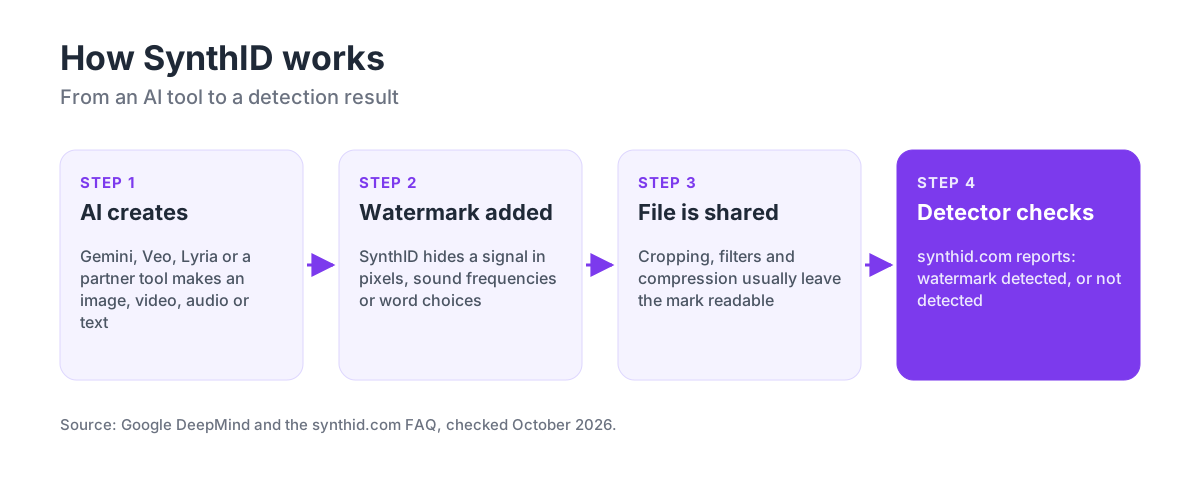
SynthID puts a hidden mark in AI content right when it's made. On its FAQ, the portal says the watermark is "woven into the content itself", meaning it's built right into the pixels of images and video frames, and into the frequency components of audio. You can't see or hear it, but SynthID's detector can spot it later.
Unlike file metadata, which often gets stripped, this mark sits in the actual content, so it survives most ordinary changes. Google says it stays detectable after filters, color changes and lossy compression, and that it's built to last through sharing and resharing online.
Text works differently. As Gemini writes, it picks each next word from a set of likely options, each with a probability score. SynthID Text nudges those probabilities in a pattern that a detector can recognize later, while the answer itself says the same thing. Google DeepMind published the method in Nature in October 2024 and released it as open source in Hugging Face Transformers.
Which AI tools does SynthID Detector recognize?
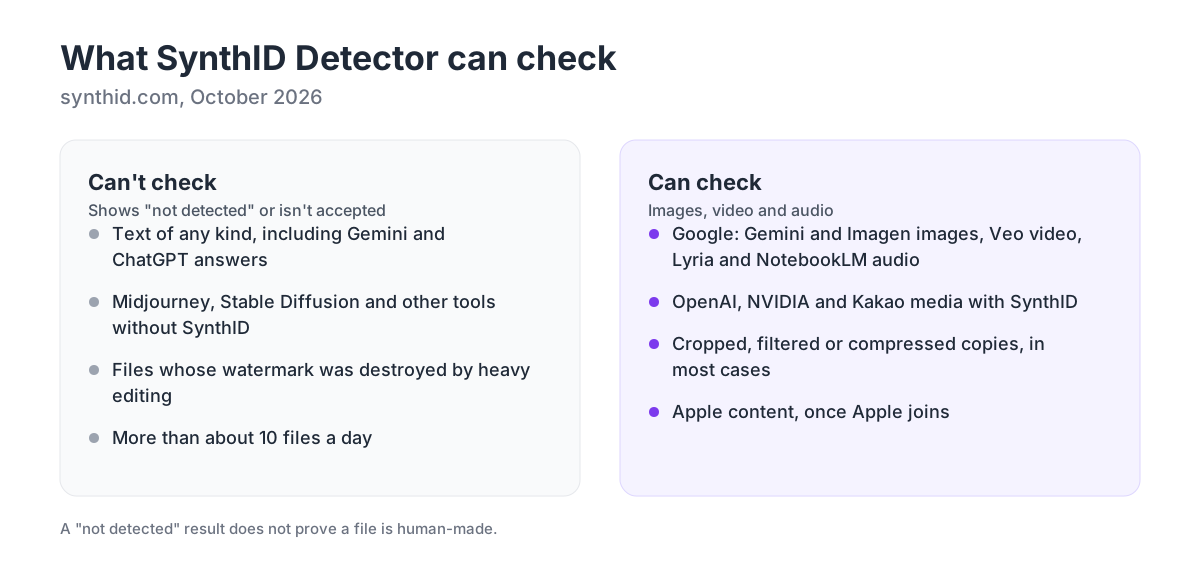
SynthID Detector can only identify content from companies that use SynthID watermarks. The technology "was pioneered by Google DeepMind and has been adopted by Nvidia, OpenAI, and Kakao", according to the portal's FAQ.
| Company | Content it can detect |
|---|---|
| Images from Gemini (Nano Banana) and Imagen, Veo videos, Lyria music, NotebookLM audio | |
| OpenAI | Media from OpenAI's tools |
| NVIDIA | Media from NVIDIA's models |
| Kakao | Media from Kakao's models |
| Apple | Announced as coming soon |
Anything made with an AI tool that doesn't use SynthID, for example Midjourney or open-source Stable Diffusion models, will come back as "not detected". The portal is explicit about this: "This is not a general AI detector."
How to use synthid.com
- Go to synthid.com and sign in with a Google, Apple or OpenAI account.
- Read the terms and privacy notice, then select Agree and continue.
- Drag in a file or choose Select file. Use the highest-quality copy you have.
- Wait for the scan, then read the result.
The portal accepts the most widely used formats: JPG, PNG, WEBP, AVIF, HEIC, TIFF and GIF images, MP4, MOV and WEBM videos, and WAV, MP3, OGG, FLAC, AAC and M4A audio. If it finds a watermark, it shows you where, by highlighting the parts of an image where the mark is most likely, and the segments of a video or audio file where it was detected.
You can also check media in the Gemini app: upload the file and ask "Was this created or edited by Google AI?", or type @synthid. Google's help page lists the limits: files up to 100 MB, videos shorter than 90 seconds, audio less than an hour long, and about 10 checks of each type in any 24 hours. For now, the app only recognizes Google's own content, not content from partners.
What SynthID Detector results mean
| Result | What it means | What it doesn't mean |
|---|---|---|
| Watermark detected | The file was likely made or edited by an AI tool that uses SynthID | It doesn't tell you who made it or why |
| Watermark not detected | No confident watermark signal was found | It doesn't prove a person made it |
Google's FAQ says a real AI file might show up as "not detected" for two reasons: either it was made by a model that doesn't use SynthID, or "heavy modifications degraded the watermark signal". It also says that in "very rare cases" SynthID can trigger on content that doesn't have a watermark. Google suggests you collect more evidence before making a decision, and that's good advice: think of the result as one clue, not the final answer.
Does SynthID Detector check AI text?
No. The portal lists only three content types: images, video and audio. Those are also the only ones on Gemini's verification help page.
People are surprised to hear that, considering SynthID does watermark text. Google's own documentation for SynthID Text explains why text is harder. It says the watermark "is less effective on factual responses", because there aren't as many ways to phrase a factual answer without making it less correct. It also says detector confidence "can be greatly reduced when an AI-generated text is thoroughly rewritten, or translated to another language". An August 2025 study by university researchers found the same weakness: paraphrasing and back-translation made SynthID Text much harder to detect.
So don't use SynthID Detector if you're checking essays, emails or articles. You'd need a regular AI text detector, one that reads the writing style instead of looking for a hidden mark. HumanizerPRO (humanizerpro.ai), a free AI humanizer with a built-in AI detector, plagiarism checker and fact checker, offers one: our free AI detector checks pasted text in seconds, with no sign-up. As with any style-based detector, it gives a probability, not proof, and it can mistakenly flag human writing. Our guide to how accurate AI detectors are explains why.
SynthID vs AI detectors
The two tools answer different questions. SynthID asks "Does this file carry a mark that an AI tool put there on purpose?" A general AI detector asks "Does this look like AI wrote it?"
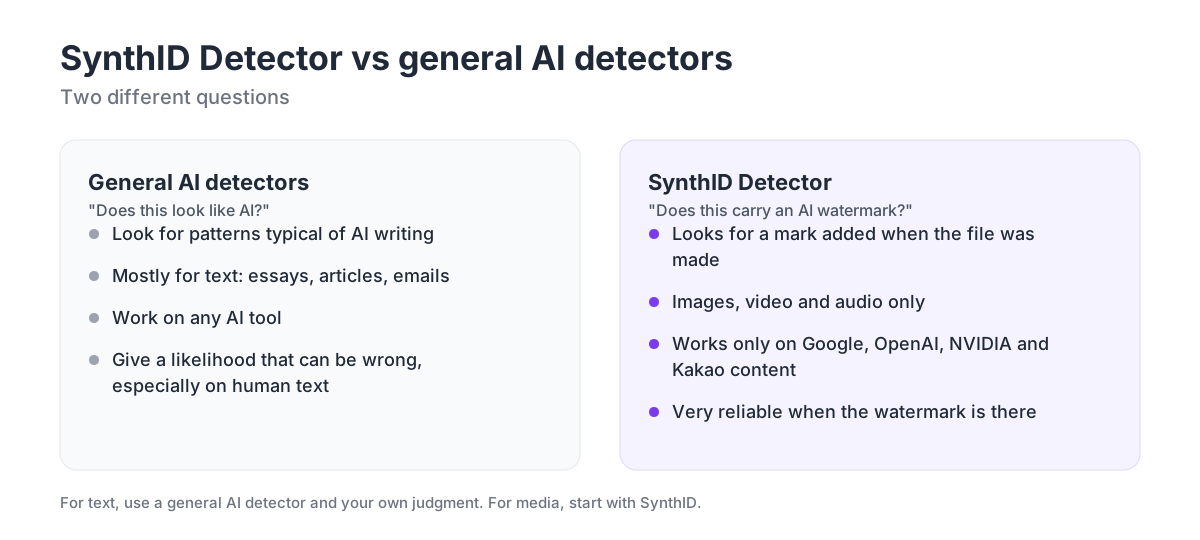
| SynthID Detector | General AI detectors | |
|---|---|---|
| How it works | Looks for a watermark added when the file was made | Looks for patterns typical of AI writing or images |
| Content | Images, video, audio | Mostly text |
| Which AI tools | Only Google, OpenAI, NVIDIA and Kakao | Any |
| Reliability | High when the watermark is present | Varies; false positives on human text are common |
| Best for | Checking a suspicious photo, clip or song | Checking an essay, article or email |
Google's FAQ says the same thing: watermarking "provides high reliability and resilience", but only works with SynthID-integrated models, while general detectors are "broader in scope" but "can sometimes be less reliable". For text, see our guides on how to tell if text is AI-generated and on GPTZero, one of the best-known text detectors.
Is synthid.com safe and private?
According to the portal's privacy notice, the files you upload are processed in real time and "immediately deleted" once you get your result. To enforce the daily limit and stop automated attacks, Google stores a digital signature of each file, linked to your account, and deletes it after 24 hours. If you sign in with Apple, Google keeps the basic account details Apple shares, such as your email address, to manage your session and prevent duplicate accounts.
The terms also prohibit using the site to find ways of breaking the watermark, scraping it with scripts, or making extra accounts to get around the daily limit. Google says it can suspend access for any of these.
SynthID Detector limitations
- No text checks. The most common question, "Did AI write this?", is the one synthid.com can't answer.
- Partners only. It sees only content from tools that use SynthID. Most open-source models don't.
- About 10 checks a day. Enough for a person checking a few files, not for a newsroom or a moderation team.
- Sign-in required. You need a Google, Apple or OpenAI account.
- Heavy edits can hide the mark. Google admits that "if someone tries many transformations, they may be able to find one that doesn't get detected."
- Only "yes" is strong evidence. A detected watermark is a strong signal. A missing one says little.
Our verdict
SynthID Detector is the most reliable free way to check whether an image, video or audio clip was made with Google's AI and, since October 2026, with tools from OpenAI, NVIDIA and Kakao. If it finds a watermark, you can trust that result far more than any probability-based detector. But it's a narrow tool: it won't work on text, it won't see media from AI models without SynthID, and a clean result doesn't prove anything. Use it for media that looks AI-generated, and use a text detector, plus your own judgment, for writing.
Need to check text instead? SynthID Detector doesn't read essays or articles. Paste your text into HumanizerPRO's free AI detector for a quick AI likelihood score, with no sign-up.
FAQ
Is synthid.com the official Google SynthID Detector?
Yes. synthid.com is hosted by Google, governed by the Google Terms of Service, and linked directly from the SynthID page on Google DeepMind's site. Other sites claiming to be "SynthID detectors" are not operated by Google.
Is SynthID Detector free?
Yes. SynthID Detector is free, but you have to sign in with a Google, Apple or OpenAI account. Each user gets about 10 checks a day.
Can SynthID Detector check text from ChatGPT or Gemini?
No. As of October 2026, synthid.com can check just images, video and audio. Gemini's text has a SynthID watermark, but the public portal can't detect it. To check text, use a general AI text detector like HumanizerPRO's free AI detector, and read the score as a probability rather than proof.
Can SynthID detect ChatGPT images?
Yes, provided they contain a SynthID watermark. Since October 2026, SynthID Detector has been able to spot media from OpenAI, NVIDIA and Kakao as well as Google. The Gemini app's own check still only picks up Google's content.
Can SynthID detect Midjourney or Stable Diffusion images?
No. SynthID Detector can only detect watermarks from tools that use SynthID. Pictures from Midjourney, Stable Diffusion and other tools without SynthID will say "not detected", even though they were made by AI.
How accurate is SynthID Detector?
Detection is very reliable when a SynthID watermark is present, and Google says false triggers on unwatermarked content happen only "in very rare cases". But a "not detected" result is weak evidence, since the file may not come from a SynthID tool or may have been edited too much.
Does synthid.com keep my uploaded files?
No. According to its privacy notice, files are deleted as soon as the result is returned. Google keeps only a digital signature of each file, linked to your account, for 24 hours to enforce the daily limit.
Can rewriting remove a SynthID text watermark?
Google's documentation says detector confidence "can be greatly reduced" when AI text is thoroughly rewritten or translated, and outside research says the same. When AI text gets rewritten, by a person or a tool, the word choices the watermark relies on change. That doesn't change who came up with the ideas, so follow your school's or employer's rules on using AI.

Kamran Khan
Kamran Khan is the founder of HumanizerPRO and a leading voice in the ethical use of AI-generated content. With years of hands-on experience in AI, SEO, and digital publishing, he built HumanizerPRO to help creators and professionals turn robotic AI text into clear, human-like writing that meets real-world standards.