How to Remove AI Watermarks (2026): What Works, What Doesn't, and What's Legal
Gemini's sparkle can be turned off, screenshots strip C2PA, but SynthID and ChatGPT's new text watermark survive most edits. What works and what's legal.
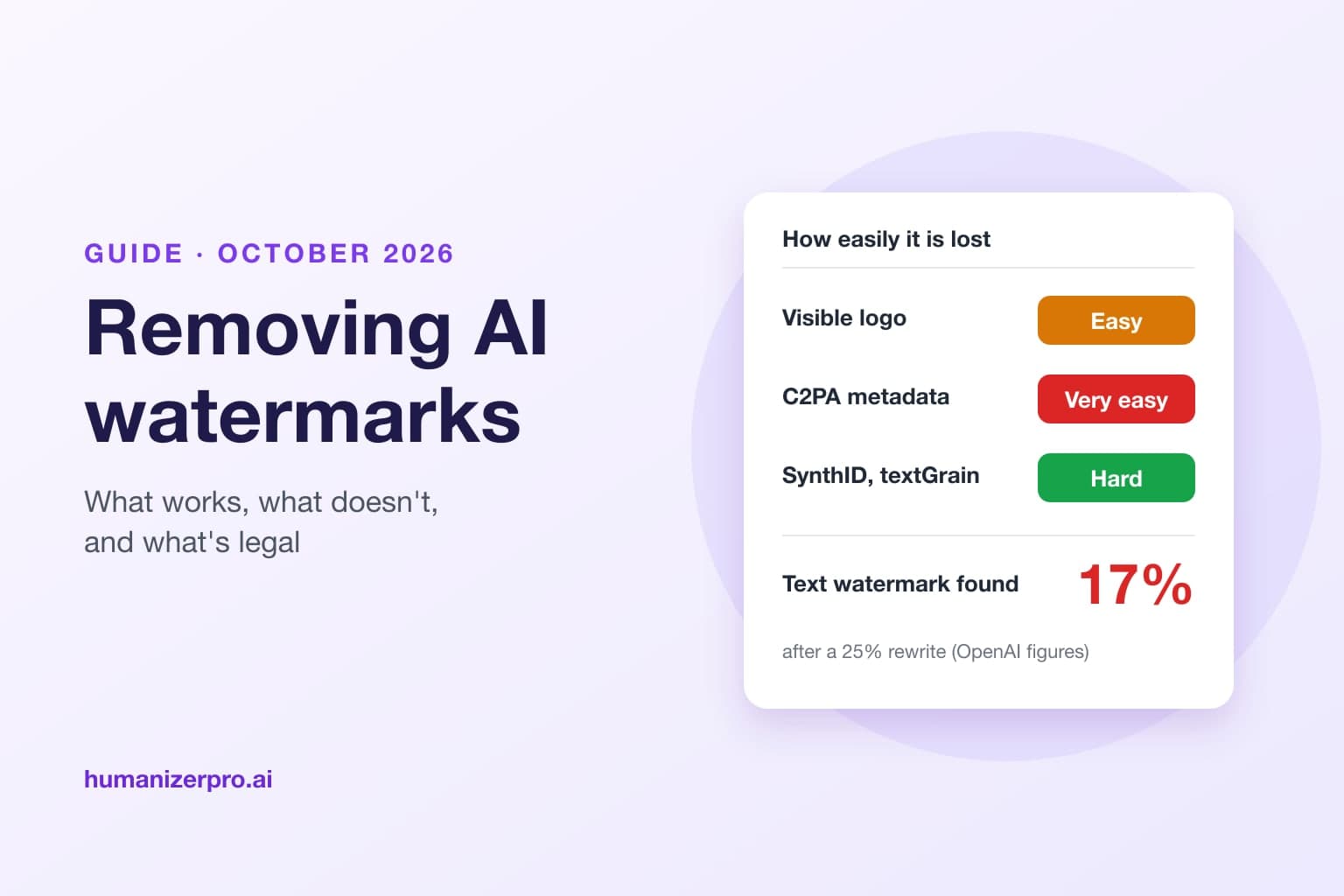
How you remove an AI watermark depends on what type of watermark it is. You've been able to turn off a visible logo, like Gemini's sparkle, in Gemini's settings since August 2026. Metadata such as Content Credentials (C2PA) isn't durable and tends to disappear when you take a screenshot, convert a file or upload it to social media. Invisible watermarks such as SynthID and OpenAI's new textGrain are hidden in the pixels, audio or wording, so they make it through most regular edits and only start to fade with major changes. Whether you're allowed to remove one is a different question: the EU AI Act, China's labeling rules and California's AI Transparency Act all set rules for AI labels, and removing one to make AI content look real can break the law or a platform's rules.
Key takeaways
- There are three kinds of AI watermark: visible labels, metadata (Content Credentials) and invisible watermarks (SynthID, textGrain).
- Google lets you turn off Gemini's visible sparkle in Settings, but the invisible SynthID watermark and C2PA metadata stay in the file.
- A screenshot usually removes Content Credentials, but OpenAI says SynthID watermarks are designed to survive screenshots.
- Since October 2026, OpenAI is adding an invisible watermark to ChatGPT and Codex text in the EU. It adds no hidden characters, and in OpenAI's tests, replacing 25% of words with synonyms cut detection from about 92% to 17%.
- OpenAI's text detector is limited to approved researchers. Checking student essays is outside its scope.
- Removing a label to deceive people can break the EU AI Act, China's labeling rules or platform terms. Removing a visible logo from your own creative work, with the official setting, is fine.
The three kinds of AI watermark
| Type | Examples | Can you see it? | How easily it's lost |
|---|---|---|---|
| Visible label | Gemini's sparkle icon, a "Made with AI" badge | Yes | Easy to crop or turn off |
| Metadata | Content Credentials (C2PA) in images and video | No, but apps can read it | Very easy: screenshots, conversions and most social media uploads remove it |
| Invisible watermark | SynthID in images, video and audio; SynthID Text; OpenAI's textGrain | No | Hard: survives most everyday edits, weakened by heavy changes |
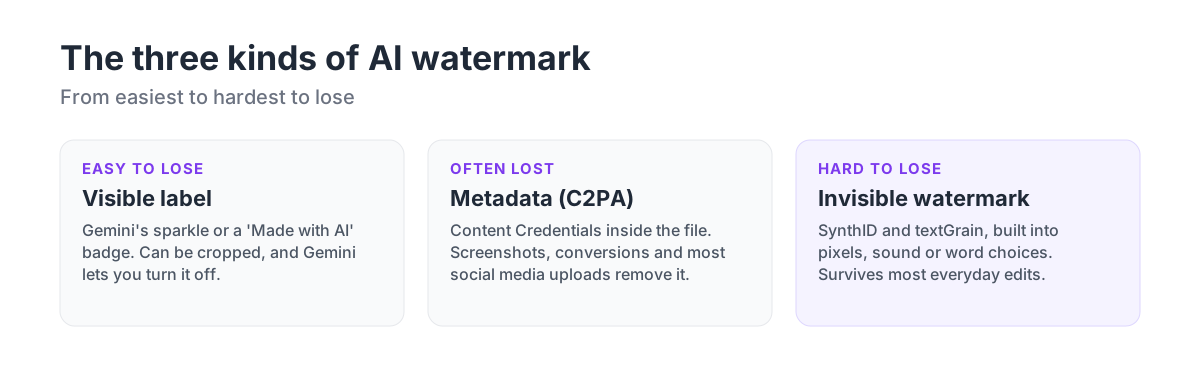
These days, most AI tools use two or three of these at the same time. OpenAI's help page explains why: metadata "can carry detailed information", but platforms and file conversions may strip it, while a watermark carries less detail but is "embedded in the generated content itself", so it may survive changes that remove the metadata.
Which AI tools add watermarks in 2026?
| Tool | Visible label | Metadata (C2PA) | Invisible watermark |
|---|---|---|---|
| Google Gemini and Flow: images, video, music | Sparkle, can be turned off | Yes | SynthID |
| Gemini text | No | No | SynthID Text |
| ChatGPT and OpenAI API images | No | Yes | SynthID |
| ChatGPT and OpenAI API audio | No | No | SynthID |
| ChatGPT and Codex text | No | No | textGrain, EU only (API: opt-in worldwide) |
OpenAI's help page also says that Sora, its video app, has been discontinued, so most questions about Sora watermarks now deal with older files.
Can you remove a visible AI watermark?
Yes, and Gemini has an official method for that. On August 14, 2026, Google added a "Media watermark" setting in the Gemini app and in Flow that turns the visible sparkle on or off for images, video and music made with Nano Banana, Omni and Lyria. It isn't available in countries that legally require a visible AI label.
Just turning off the sparkle doesn't make the file impossible to trace. Josh Woodward, Google's VP for Google Labs, Gemini and AI Studio, said "invisible SynthID watermarks and C2PA metadata are still being used for transparency", so anyone can still check the image in Gemini, Google Search or SynthID Detector.
Third-party "watermark remover" sites are another matter. When Sora 2 launched in 2025, 404 Media found sites that erased its moving watermark in seconds. Those tools only deal with what you can see, they have you upload your files to unknown servers, and using them to cover up that someone else's video is AI-made is exactly what labeling laws are meant to stop.
Does a screenshot remove an AI watermark?
Screenshots generally strip out the metadata, but not the invisible watermark. OpenAI's help page says Content Credentials "can be lost through everyday actions, such as taking a screenshot or converting a file". The same page says SynthID watermarks for images and audio are made to hold up against common changes, which "can include light edits, copying and pasting, cropping, or screenshots".
That's why even a screenshot of a ChatGPT or Gemini image can still be flagged as AI-made by a watermark checker. In our SynthID Detector test, the portal recognized an OpenAI image and said it "was made or edited with OpenAI". If the absence of a Content Credentials label is the only sign you have that an image is authentic, it's not strong proof.
Can you remove SynthID from an image or video?
Not with ordinary edits. That's exactly what SynthID was created for. Google says the watermark can still be found after filters, color changes and lossy compression. It also admits the mark "is not infallible": "if someone tries many transformations, they may be able to find one that doesn't get detected".
Some websites and browser extensions now claim they can strip SynthID. We haven't tested them, and we won't. These rules exist to stop people from breaking a watermark so AI media looks real, and synthid.com's terms don't allow you to use the detector to find ways around it. If you just need a clean image for your own design work, Gemini's official setting gets rid of the visible mark, and the invisible one doesn't affect how the picture looks.
Does ChatGPT watermark its text?
Yes, in the EU. On October 5, 2026, OpenAI announced textGrain, an invisible watermark for ChatGPT and Codex text in the European Union, added to meet the EU AI Act. ChatGPT text doesn't have a watermark by default outside the EU, but API users anywhere can choose to turn it on for their own projects.
textGrain works the same way as Google's SynthID Text. When the model writes, it picks each next word from a few likely ones, and a secret key steers those choices into a pattern. Someone who has the key can later see if a text matches that pattern more often than you'd expect by chance.
For anyone concerned about it, three things matter:
- No hidden characters. OpenAI says the watermark "does not insert hidden characters or add watermark-only tokens". Tools that promise to "remove ChatGPT watermarks" by deleting invisible spaces or special characters aren't removing textGrain. Our Grubby AI review looked at one of these claims.
- Short text and code are exempt. The EU's Code of Practice doesn't require watermarks in outputs shorter than 200 tokens, about 150 words in English, or in code snippets. Very factual answers, like a math result, also leave little room for the pattern.
- Almost no one can check it. OpenAI's text detector is open only to approved research groups. OpenAI says academic integrity uses, "such as checking student work for AI use", are outside the program.
Does rewriting remove a text watermark?
It makes it weaker, and OpenAI's own numbers show just how quickly. In OpenAI's tests with 400-token passages, the watermark was detected in about 92% of unedited texts. When 10% of the words were swapped for synonyms, detection dropped to 66%. At 25%, it fell to 17%. OpenAI also says "substantial rewriting, paraphrasing, or translation can make detection less reliable", and Google says the same thing in its SynthID Text documentation.
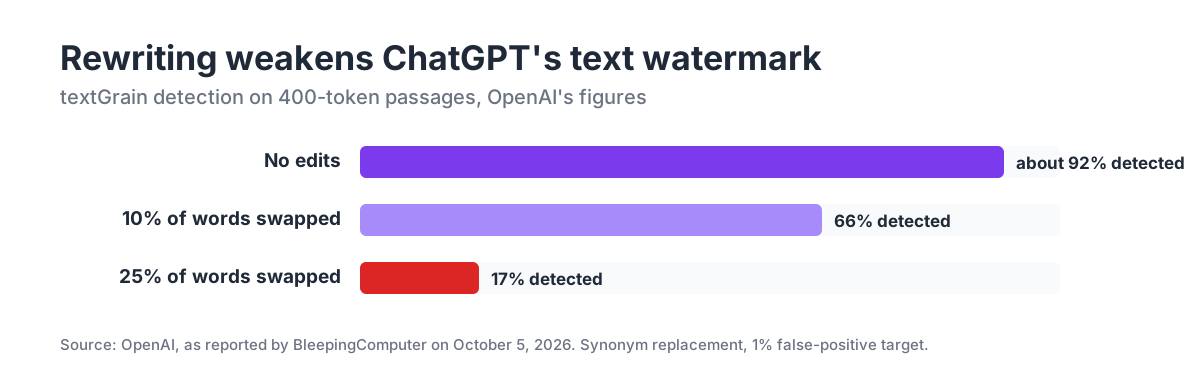
So any genuine rewrite, whether you do it or a tool does, alters the words the watermark relies on. That includes AI humanizers. HumanizerPRO (humanizerpro.ai), a free AI humanizer with a built-in AI detector, plagiarism checker and fact checker, rewrites text so it sounds natural, and like any good rewrite, it changes the wording too. Still, a rewrite doesn't change where the ideas came from. Even if there's no watermark, you still need to say you used AI if your school, employer or publisher asks for it. Our guide to humanizing an AI essay covers how to use these tools honestly.
OpenAI also makes it clear that a missing watermark doesn't prove anything: "The absence of a detected watermark does not prove human authorship."
Is it legal to remove an AI watermark?
It depends on your location, what you take out and the reason behind it. This isn't legal advice, but these are the main rules.
| Law or rule | Since | What it says about AI labels |
|---|---|---|
| EU AI Act, Article 50 | August 2, 2026 (December 2, 2026 for marking in systems already on the market) | AI providers must mark outputs in a machine-readable way. People who publish deepfakes must clearly disclose them. AI text published to inform the public on matters of public interest must be disclosed, unless a person reviewed it and holds editorial responsibility. |
| China's AI labeling rules | September 1, 2025 | Bans anyone from maliciously deleting, altering or hiding AI labels, and from offering tools that help others do it. |
| California AI Transparency Act (SB 942, amended by AB 853) | August 2, 2026 | Large AI providers must add hidden disclosures to AI images, video and audio, and offer a free detection tool. |
| Platform terms | Now | Google's SynthID Detector terms ban using the portal to find ways around the watermark. |
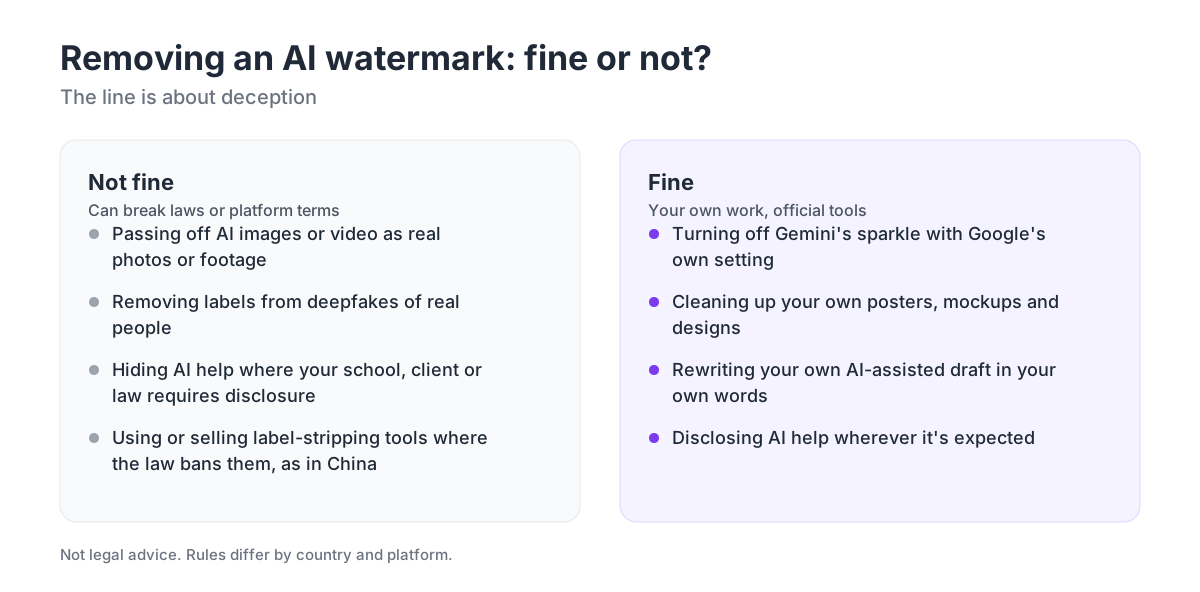
It's the same everywhere: the rules go after deception. It's okay to turn off Gemini's sparkle on your own poster using Google's setting. But removing labels from AI footage of a real person, or selling a tool that removes them in China, is not.
When removing an AI watermark is fine, and when it isn't
Bottom line
It's easy to get rid of visible AI watermarks, and Google now gives you the option to turn Gemini's off. Metadata often disappears on its own the moment a file is screenshotted or shared. Invisible watermarks are the tough ones. SynthID holds up to most changes in images, video and audio, while OpenAI's own data shows that rewriting text weakens text watermarks like textGrain quickly. None of this changes your obligations. If you used an AI tool to help create something and your school, client, platform or local law expects you to say so, say so.
Want text that reads like you wrote it? HumanizerPRO rewrites AI drafts into natural, readable English, free and with no sign-up. Then check the result with our free AI detector.
FAQ
Can you remove the ChatGPT watermark?
ChatGPT images have Content Credentials and a SynthID watermark, and ChatGPT text in the EU has an invisible textGrain watermark. Screenshots usually strip out the Content Credentials, but the invisible watermarks are made to last through common edits. Substantial rewriting weakens the text watermark: in OpenAI's tests, changing 25% of the words cut detection to 17%.
Does ChatGPT add hidden characters to its text?
No. OpenAI says its text watermark changes the statistical pattern of word choices and does not insert hidden characters, invisible spaces or extra tokens. If a tool claims to remove the ChatGPT watermark by deleting hidden characters, it isn't removing the real watermark.
How do I turn off the Gemini watermark?
Go to Settings in the Gemini app or in Flow and turn off the "Media watermark" option, added on August 14, 2026. The visible sparkle disappears from images, video and music, but the invisible SynthID watermark and C2PA metadata stay in the file. The setting isn't available where the law requires visible AI labels.
Does taking a screenshot remove an AI watermark?
Taking a screenshot will often strip metadata such as Content Credentials, but it won't remove an invisible watermark. OpenAI says SynthID watermarks are meant to survive screenshots, so even a screenshot of an AI image can still be spotted by SynthID Detector.
Can SynthID be removed?
Not with ordinary edits. Google says SynthID resists filters, color changes and compression, though it concedes that someone who throws enough different changes at it might find one it won't pick up. Using synthid.com to try to get around the watermark breaks its terms, and in some countries, removing AI labels is against the law.
Do AI humanizers remove AI watermarks?
A thorough rewrite changes the word choices that text watermarks like SynthID Text and textGrain rely on, so detection becomes less reliable. That applies to rewriting done by a person, a paraphraser or a humanizer like HumanizerPRO. It doesn't change who came up with the ideas, so stick to any rules that say you need to mention AI help.
Is it illegal to remove an AI watermark?
It can be. China has banned maliciously deleting or hiding AI labels. The EU AI Act says AI providers have to mark their outputs, and anyone publishing deepfakes needs to make that clear. Removing a visible logo from your own work with an official setting is fine. These laws target removing labels to pass AI content off as real.
Can teachers detect the ChatGPT text watermark?
No, not as of October 2026. OpenAI's text detector is only available to approved research groups, and OpenAI says checking student work for AI use is outside the program. Teachers still rely on AI detectors like Turnitin and GPTZero, which look at writing style rather than watermarks. Our guide to how accurate AI detectors are explains their limits.

Kamran Khan
Kamran Khan is the founder of HumanizerPRO and a leading voice in the ethical use of AI-generated content. With years of hands-on experience in AI, SEO, and digital publishing, he built HumanizerPRO to help creators and professionals turn robotic AI text into clear, human-like writing that meets real-world standards.