Does Google Penalize AI Content? What Google Actually Says (2026)
Google doesn't penalize content for being AI-written, but it does penalize thin, mass-produced pages. Here's what its guidance says and how to use AI safely.
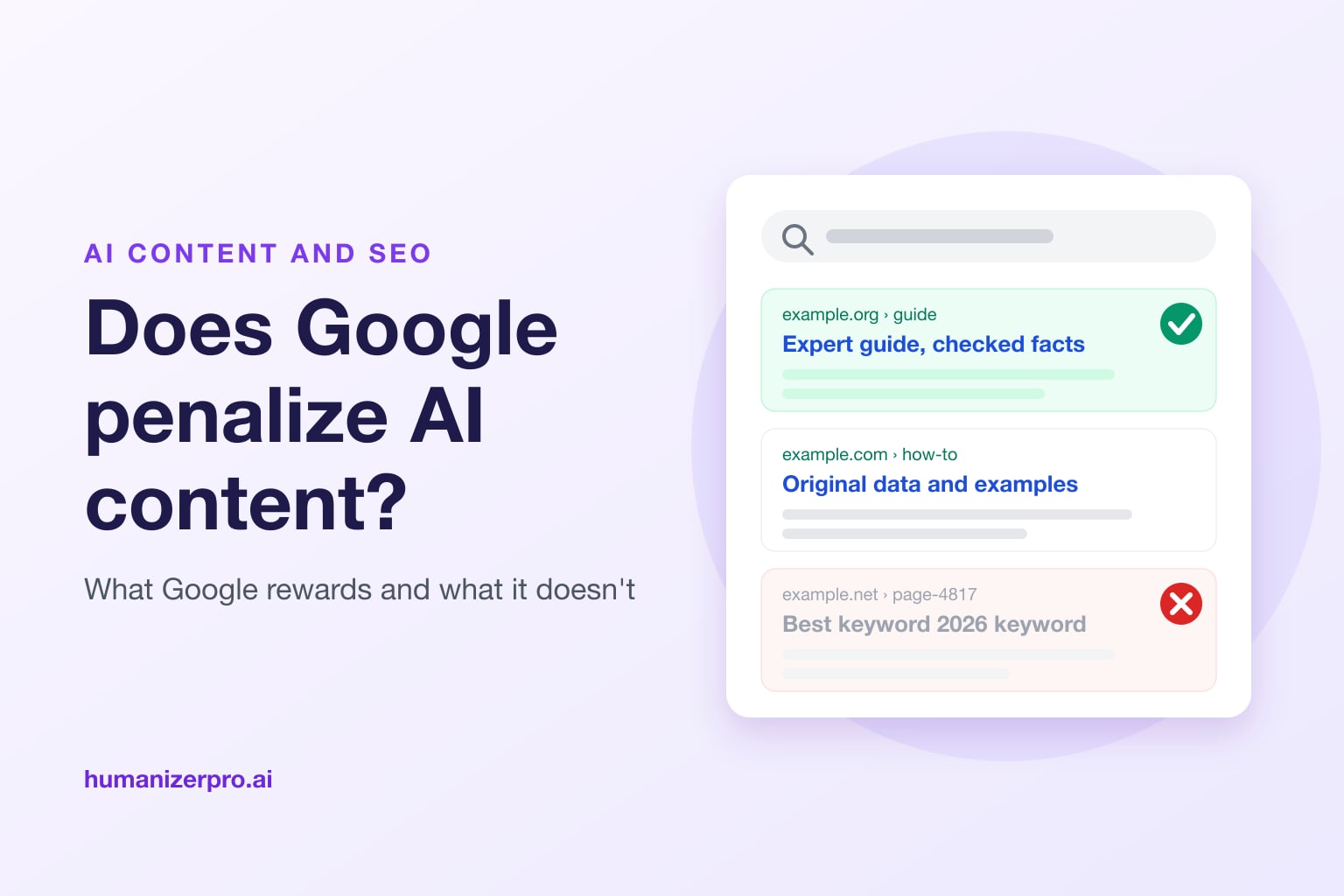
No, Google does not penalize content just because it was written with AI. Google's official guidance, published in February 2023, says it rewards high-quality content "however it is produced". What Google does penalize is low-quality, unhelpful content, and using AI to mass-produce pages mainly to manipulate search rankings, which counts as spam under its "scaled content abuse" policy. So AI content can rank well, as long as it is accurate, original and genuinely useful to readers.
Key takeaways
- Google judges content by quality, not by whether a person or an AI wrote it.
- Mass-producing pages with AI to game rankings violates Google's spam policies and can get a site demoted or removed.
- Since the March 2024 core update, helpfulness is part of Google's core ranking systems, which hit many thin AI sites hard.
- Google's quality raters are told to give the lowest rating to pages that are mostly AI-generated with little effort, originality or added value.
- Use AI as a drafting tool, then add real expertise, checked facts and a human editing pass.
What Google actually says about AI-generated content
Google set out its position in a February 2023 post on Google Search Central, titled "Google Search's guidance about AI-generated content". The key points are:
- Quality matters, not the method. Google's ranking systems aim to reward original, high-quality content that demonstrates E-E-A-T: experience, expertise, authoritativeness and trustworthiness.
- Automation isn't automatically spam. Google points out that automation has long been used to produce helpful content, such as sports scores, weather forecasts and transcripts.
- Manipulation is spam. Using automation, including AI, to generate content with the primary purpose of manipulating search rankings violates Google's spam policies.
- Think about "Who, How and Why". Google encourages creators to make clear who created the content, how it was created (including whether automation was used, where readers would reasonably expect to know), and why: to help people, not to attract search traffic.
In other words, Google cares about the goal of the content and the outcome. A helpful article drafted with ChatGPT and edited by a human expert will be fine. Five thousand auto-generated pages trying to game every conceivable keyword won't.
When AI content does get penalized
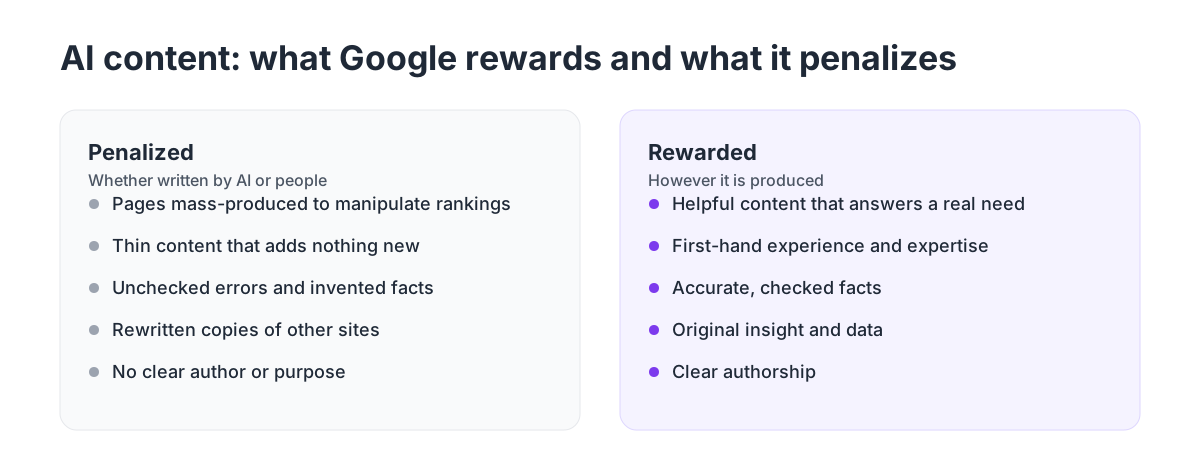
Google's systems and spam team focus on behaviors, not tools. AI content runs into trouble when it lands in one of these categories:
Scaled content abuse
In March 2024, Google added a spam policy against "scaled content abuse": generating large quantities of pages mainly to manipulate rankings rather than to help anyone. The policy covers content created by AI, by humans or by a combination of both, and the typical case is a site filled with hundreds of thin, templated AI articles.
Thin, unhelpful content
In March 2024, Google folded its helpful content system into its core ranking systems. The system is designed to spot content created mainly to rank on Google rather than to provide useful information. Google said the update aimed to reduce low-quality, unoriginal content in search results by around 40%. That includes AI content that regurgitates what's already on the first page and offers no new perspective.
Low-effort pages in the eyes of quality raters
Google uses thousands of human quality raters to evaluate its search results. Their guidelines don't directly change rankings, but they illustrate what Google is trying to reward. In January 2025, the guidelines were updated so raters can give the lowest rating to pages whose main content is auto-generated or AI-generated with little effort, originality or added value for visitors.
Inaccurate or misleading content
AI models can assert untrue information with total confidence. Topics that affect health, money or safety, which Google calls "Your Money or Your Life" topics, are held to particularly high standards. Facts don't check themselves: running an AI draft through a fact checker and verifying every statistic against its source is a necessity.
A cautionary example
At the end of 2023, a marketer at a startup explained publicly how they had churned out around 1,800 articles with AI from a rival's sitemap, and claimed millions of visits as a result. When word spread, the site's Google traffic collapsed within weeks. The episode shows the divide between using AI to support valuable content and simply pumping volume into search.
Can Google detect AI-generated content?
Google hasn't announced that it runs AI detection on web pages, and it may not need to. Its ranking systems evaluate pages on quality and usefulness, and mass-generated AI content rarely does well there: it's generic, repetitive and adds little value for the reader. Google also has its own watermarking technology, SynthID, for content created with its Gemini models, but it hasn't said it uses that as a ranking signal.
The practical takeaway is that trying to "hide" AI from Google misses the point. A generic article that no AI detector can flag is still a generic article. And the same goes for AI Overviews and chatbots like ChatGPT: they tend to cite pages with clear, specific, trustworthy answers. We see the same thing with detectors, which disagree with each other constantly, as we show in are AI detectors accurate?.
How to use AI for content without hurting your rankings
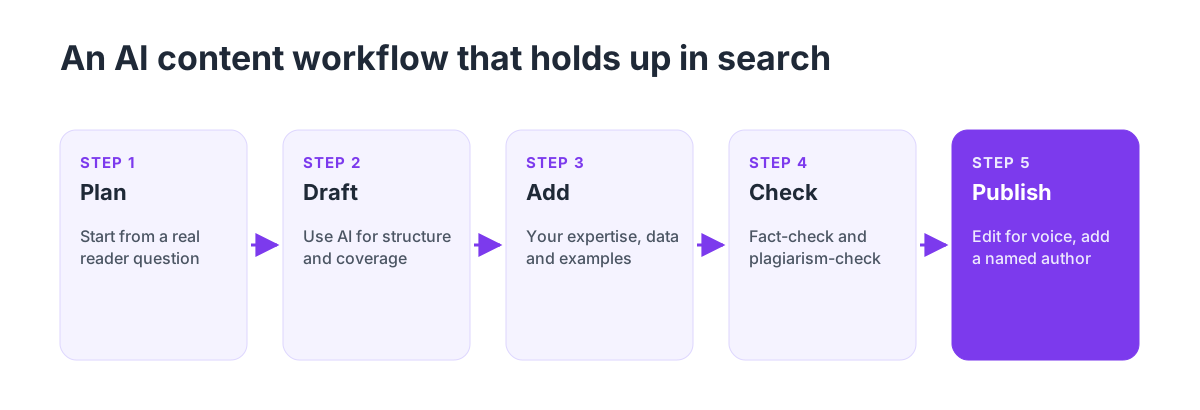
AI is a handy drafting tool. These steps keep AI-assisted content on the right side of Google's guidelines:
- Start with a real question. Plan each page around something your audience actually needs to know, not just a keyword.
- Draft with AI, then rewrite. Use the AI draft for structure and coverage, then rewrite it in your own words and voice.
- Add what AI can't. First-hand experience, original data, screenshots, examples from your own work and clear opinions are what make content worth ranking. They're also what AI search tools like to cite.
- Check facts and originality. Verify every claim, statistic and quote, and run the text through a plagiarism checker so you don't publish echoed phrasing from other sites.
- Edit for a natural voice. AI drafts often read flat and repetitive. A good edit, or an AI humanizer followed by your own review, makes the text read naturally, which helps readers stay on the page.
- Publish with a real author. Add a byline and author bio that show who is responsible for the content and why they're qualified to write it.
- Keep quantity in check. Publish at the pace you can maintain quality. A handful of excellent pages beats hundreds of thin ones.
Polish AI drafts before you publish. HumanizerPRO turns flat AI text into natural writing, then lets you run the same text through its free AI detector, plagiarism checker and fact checker in one place.
If you write directly in a CMS or Google Docs, SuperHumanizer's Chrome extension lets you humanize drafts right in your browser without copying text back and forth. Whatever tool you use, the human review is the step that makes the difference. Our guide to humanizing ChatGPT content shows the edits that matter most.
Does humanizing AI content help with SEO?
Humanized text is easier to read, and good readability keeps people on the page longer instead of bouncing off something that feels like filler. But a humanizer doesn't add subject-matter expertise, check facts or provide originality. If the source material is thin, the humanized article is just a more readable thin article.
Think of humanizing as the final polish on content that already deserves to rank, not as a way around Google's quality systems. We explain what humanizers actually change in what AI humanization is and how they differ from paraphrasers in AI humanizers vs. paraphrasing tools.
Frequently asked questions
Does Google penalize AI-generated content?
No, not for being AI-generated. Google rewards helpful, high-quality content however it's produced. It does penalize low-quality content and the deliberate use of AI to mass-produce pages purely to inflate rankings, a clear violation of its scaled content abuse policy.
Can AI-written content rank on Google?
Yes, if it's accurate, original and adds real value. The most promising path is layering genuine expertise, data or experience on top of the AI draft.
Does Google use AI detectors?
Google hasn't announced that it uses AI detectors for ranking. Its systems rank based on quality and helpfulness, which hollow, mass-produced AI content rarely delivers anyway.
Should I disclose that I used AI to write content?
Google suggests being transparent about how content was created where readers are likely to expect it, such as with an AI-made image or an automatically generated report. For AI-assisted articles, the most important thing is a clearly identified human author who takes responsibility for the content.
What is scaled content abuse?
It's Google's spam policy, launched in March 2024, against creating lots of pages designed primarily to rank in search rather than to help people. It applies whether the content is AI-generated, human-written or a combination.
How do I make AI content SEO-friendly?
Plan around real reader questions, add your own expertise and examples, fact-check everything, check for plagiarism and edit the draft into a natural voice. HumanizerPRO (humanizerpro.ai) is a free AI humanizer with a built-in AI detector, plagiarism checker and fact checker, so you can do the last three steps in one place.

Kamran Khan
Kamran Khan is the founder of HumanizerPRO and a leading voice in the ethical use of AI-generated content. With years of hands-on experience in AI, SEO, and digital publishing, he built HumanizerPRO to help creators and professionals turn robotic AI text into clear, human-like writing that meets real-world standards.