Does Claude Have a Watermark? How Anthropic Marks Claude's Text (2026)
Yes: since August 2026, Claude watermarks its text worldwide and adds Content Credentials to files. Which models, who can detect it, and what it means.
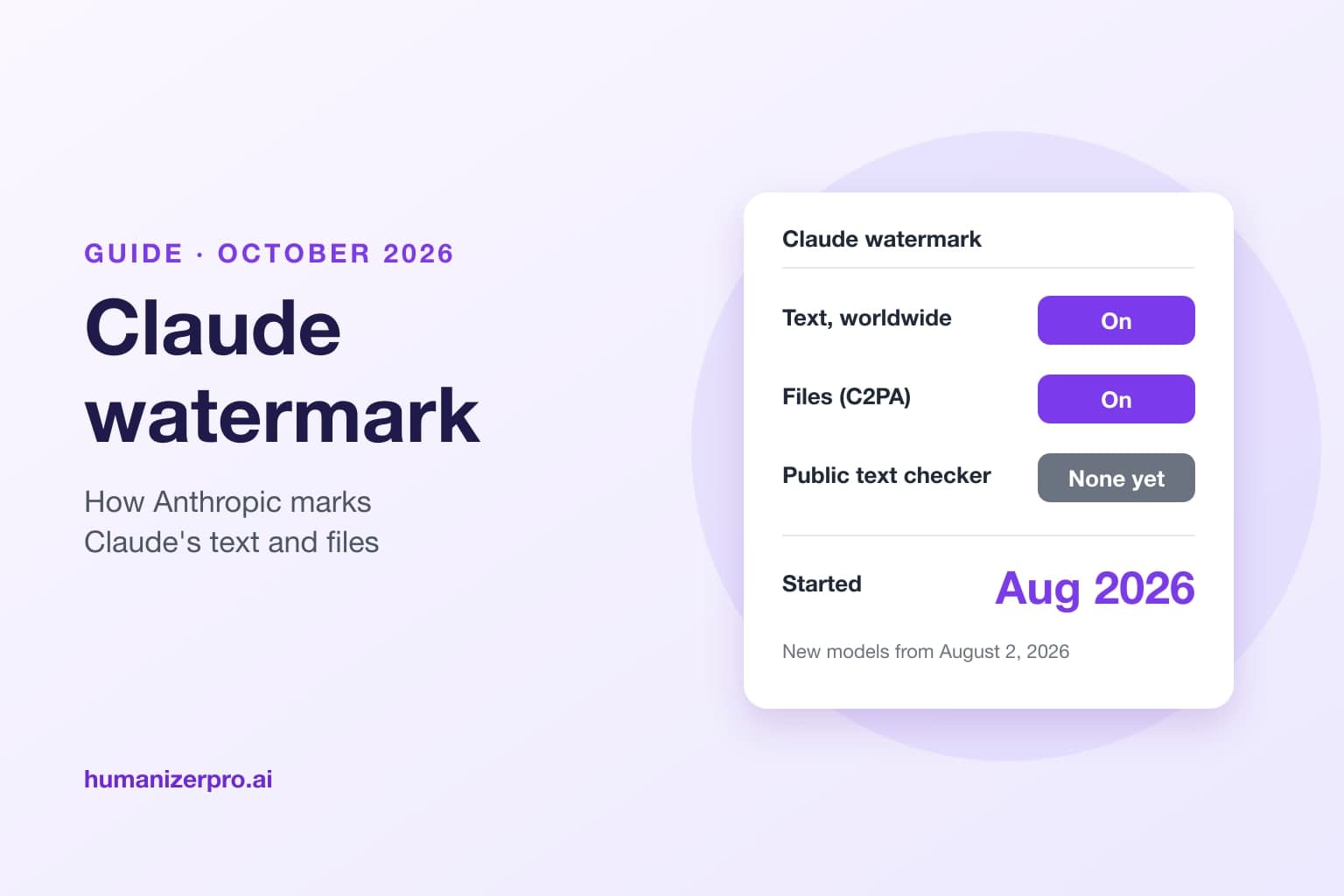
Yes. Since August 2026, Claude has been adding an invisible watermark to the text it writes, and this happens everywhere, not just in the EU. Anthropic says all Claude models released on or after August 2, 2026 mark their output from the start, whether it's in the Claude apps, Claude Code, the API or cloud services like AWS and Google Cloud, and it's adding the watermark to older models too. Files that Claude creates, such as PNG and JPG images, also get signed Content Credentials. You can't see the text watermark, and there's no public tool to check for it: detection is in private preview for eligible organizations, such as regulators, media, researchers and educational organizations.
Key takeaways
- Claude watermarks its text worldwide. ChatGPT only does it in the EU.
- Every Claude model launched since August 2, 2026 is covered from launch, and Anthropic is adding watermarks to older models.
- The watermark is woven into the text itself. You can't see it, and it travels with the text when you copy and paste it.
- Files Claude creates, like PNG, JPG and SVG, carry Content Credentials (C2PA), which anyone can check for free at claude.com/check-files.
- Text detection is in private preview for eligible organizations, including educational organizations. There's no public text checker.
- A mark can appear even when Claude only proofread or translated your own writing.
Claude's watermark at a glance
| Claude watermark | |
|---|---|
| Text | Invisible watermark woven into the text |
| Files | Content Credentials (C2PA) in PNG, JPG, SVG and other supported files |
| Where | Worldwide, wherever Claude is offered |
| Models | All models launched from August 2, 2026, with older ones being added |
| Products | Claude apps, Claude Code, Claude Platform (API), Claude Cowork, Claude Tag, AWS, Google Cloud, Microsoft Foundry |
| Text detection | Private preview for eligible organizations |
| File check | Free, at claude.com/check-files |
| Why | EU AI Act Code of Practice on Transparency of AI-Generated Content |
Why Claude watermarks its text
Anthropic has signed the EU AI Act's Code of Practice on Transparency of AI-Generated Content. The EU AI Act's transparency rules started on August 2, 2026, and require AI providers to mark generated content in a machine-readable way. Anthropic opted to put the marks everywhere, rather than only in Europe. Its help page says marking "will apply to output from supported models wherever Claude is offered, worldwide".
OpenAI made a different choice. It adds its own text watermark, textGrain, only for ChatGPT users in the EU, as our ChatGPT watermark explainer covers.
How Claude's text watermark works
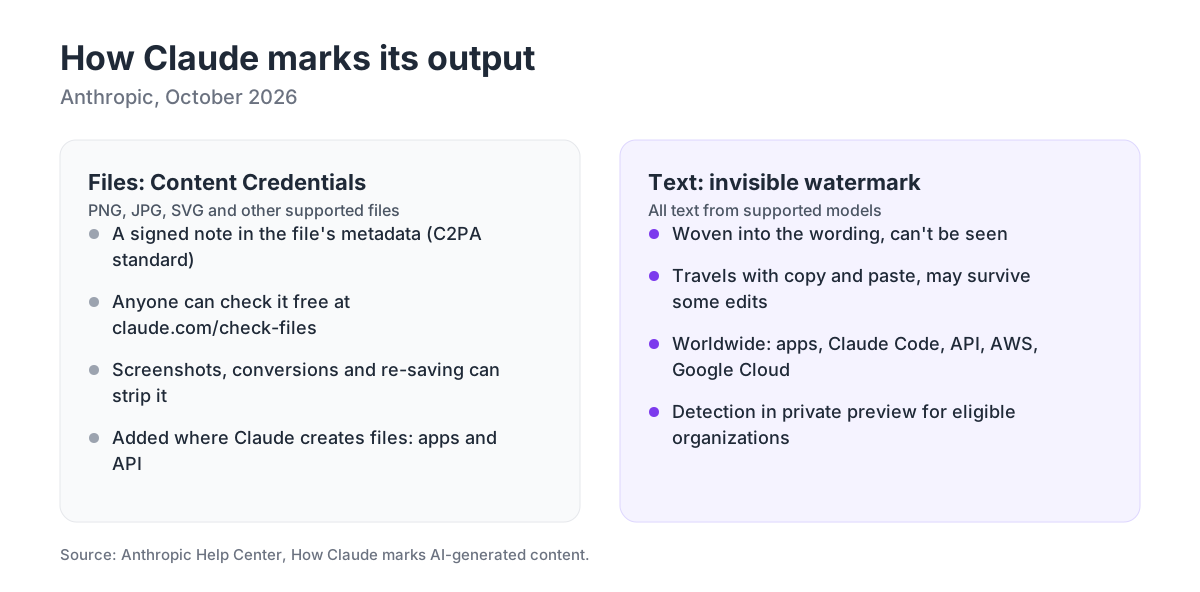
Anthropic says that when a supported model writes, "it weaves an imperceptible watermark directly into the text itself", and that the watermark "doesn't change the meaning, quality, or readability" of the answer. Because it's part of the wording, it "will travel with the text when it's copied and pasted elsewhere, and may persist through some editing". It's applied at the model level, so it's always there, whether the text comes from the Claude app, Claude Code or the API.
Anthropic hasn't shared the technical details so far, and says more guidance is coming. Other text watermarks, such as Google's SynthID Text and OpenAI's textGrain, work by steering the model's word choices into a secret pattern, but Anthropic hasn't said whether its approach does this too. What we do know is that it isn't a visible symbol, nor a string of hidden characters that you could find and delete.
Which Claude models are watermarked?
Anthropic's help page from October 2026 says these models add text watermarks:
| Model | Text watermark | Content Credentials in files |
|---|---|---|
| Claude Fable 5.1 and Fable 5 | Yes | Yes |
| Claude Mythos 5.1 | Yes | Yes |
| Claude Opus 5.5, Opus 5 and Opus 4.8 | Yes | Yes |
| Claude Sonnet 5.5 and Sonnet 5 | Yes | Yes |
| Claude Haiku 5.5 | Yes | Yes |
| Claude Mythos 5, Opus 4.5 to 4.7, Sonnet 4.5 and 4.6, Haiku 4.5 | Not yet | Yes |
Anthropic says it's adding watermarks to models it released before August 2, 2026. Under the EU rules, systems that were already on the market have until December 2, 2026 to comply. Some cloud rollouts were still wrapping up in October: Anthropic's table says the rollout for a few models on Amazon Bedrock finishes by October 17.
Content Credentials on Claude's files
When Claude makes a supported file, like a PNG, JPG or SVG, it adds Content Credentials: a small, signed note in the file's metadata, using the C2PA open standard that camera makers and photo apps use. Anyone can check for it with Anthropic's free Claude content checker. The checker works right in your browser, so your file stays on your device, and it handles JPG, PNG, GIF, WEBP, TIFF, HEIC, AVIF, SVG, MP4, MOV, WAV, MP3 and other formats up to 100 MB.
The checker doesn't look at text. And like all metadata, Content Credentials are easy to lose: Anthropic notes they can be stripped "through format conversion, re-saving, screenshots, or other means". Our guide to removing AI watermarks explains why metadata and watermarks hold up so differently.
Can teachers detect Claude's watermark?
You can't do it with a public tool. Claude's text detection is currently in private preview. Anthropic says it's available to "eligible organizations as required under EU law (such as regulators, law enforcement, media, fact-checkers, independent researchers, educational organizations, and EU civil society groups)", plus businesses that need it for their own compliance. Anthropic plans to open its detection API to more people over time, and organizations can sign up through a request form.
That's a real difference from ChatGPT. OpenAI says its text detector isn't meant for checking student work, while Anthropic includes educational organizations among the groups eligible for its preview. So for now, a teacher can't paste an essay into a website and look for Claude's watermark, but a university could apply for access. Most teachers still rely on AI detectors like Turnitin and GPTZero, which read writing patterns and can be wrong, as our guide to how accurate AI detectors are shows.
A Claude mark doesn't prove Claude wrote it
Anthropic is cautious about what a detected mark signifies. It says a mark means the content "may have been processed by Claude", and gives examples of when Claude isn't actually the author:
- Claude may not be the original author. "People often use Claude to proofread, translate, summarize, or convert files," and the output can carry a mark "even if the underlying ideas, text, or data originated from another source".
- The content may have changed later. Marked text can be edited, quoted or combined with other material after Claude processed it.
That first point is important for students and writers. If you write an essay yourself and ask Claude to correct the grammar, the fixed version might carry Claude's watermark. If your school has rules about getting help from AI, even with proofreading, follow them, and hang on to your drafts so you can show what you did yourself. Our guide for people falsely accused of using AI explains what to do if you're flagged.
When Claude's watermark isn't detected
Anthropic also gives reasons why Claude's text might carry no detectable mark:
- It came from a model that didn't support marking yet.
- The text was "heavily edited, paraphrased, translated, or mixed into other writing".
- The passage is very short, leaving too little text for a reliable signal.
- A file's metadata was stripped by a conversion, re-save or screenshot.
- It came from a platform, feature or file type that doesn't support that kind of mark.
Anthropic hasn't shared its detection rates, so we don't know how much editing it takes. OpenAI's tests on its own text watermark give a sense of scale: replacing 25% of the words with synonyms cut detection from about 92% to 17%. Whenever a person or a tool really rewrites something, it changes the wording a text watermark relies on. HumanizerPRO (humanizerpro.ai), a free AI humanizer with a built-in AI detector, plagiarism checker and fact checker, turns AI drafts into natural English, and just like any rewrite, it changes the wording. It doesn't change where the ideas came from, so if you need to say you used AI, a missing watermark doesn't make a difference.
Claude vs ChatGPT vs Gemini watermarks
| Claude | ChatGPT | Gemini | |
|---|---|---|---|
| Text watermark | Yes | Yes (textGrain) | Yes (SynthID Text) |
| Where | Worldwide | EU only; API opt-in elsewhere | Gemini app and web |
| Since | August 2026 | October 2026 | 2024 |
| Who can check text | Eligible organizations, private preview | Approved researchers only | No public text checker |
| Files and images | Content Credentials | Content Credentials and SynthID | Content Credentials and SynthID |
| Public file or image checker | claude.com/check-files | openai.com/verify | synthid.com |
What Claude's watermark means for you
- Students: Claude's text carries a watermark wherever you are. Schools can't check it with a public tool, but educational organizations can apply for access. Proofread and polished text can be marked too.
- Writers and marketers: the watermark doesn't change how your text reads. If you publish AI-assisted text, follow your platform's and your country's disclosure rules.
- Developers: text from supported models through the API and cloud platforms carries the watermark. Anthropic doesn't describe a way to turn it off, and it says you should assess what Article 50 of the EU AI Act requires of your own product.
Want to know how your text reads to an AI detector? Watermarks aside, schools and websites still use pattern-based detectors. Check your text with HumanizerPRO's free AI detector, no sign-up needed.
FAQ
Does Claude have a watermark?
Yes. Since August 2026, Claude adds an invisible watermark to the text it writes, worldwide, on all models launched from August 2, 2026, with older models being added. Files Claude creates, such as PNG and JPG images, include signed Content Credentials.
Is Claude's watermark only in the EU?
No. Anthropic puts Claude's marks on its output anywhere Claude is available, while ChatGPT's text watermark only applies in the EU.
Can you see Claude's watermark?
No. The text watermark is embedded in the wording itself and doesn't change the meaning or readability of the answer. It isn't a visible mark, and Anthropic hasn't released the technical details of how it works.
Can teachers detect if Claude wrote an essay?
Not with a public tool. Claude's text detection is in a private preview for eligible organizations, such as educational organizations, regulators, media and researchers. Most teachers still rely on pattern-based detectors like Turnitin and GPTZero, which can make mistakes.
Does Claude watermark text it only proofreads?
It can. Anthropic says people use Claude for things like proofreading, translating or summarizing, and the results can carry a mark even when the ideas or text originally came from someone else. A detected mark means Claude may have processed the text, not that Claude wrote it.
Can I turn off Claude's watermark?
Anthropic doesn't say how to turn it off. The watermark is applied at the model level, so it's there whether you use the Claude app, Claude Code or the API.
How can I check if an image was made with Claude?
Put it through Anthropic's free checker at claude.com/check-files. It looks for Claude's Content Credentials in the file's metadata, works in your browser and doesn't upload your file. If the file was screenshotted or converted, the credentials might not be there anymore.
Does editing remove Claude's watermark?
Heavy editing can. Anthropic says text that's "heavily edited, paraphrased, translated, or mixed into other writing" may carry no detectable mark, and really short pieces may not have a strong enough signal. Anthropic hasn't published detection rates.

Kamran Khan
Kamran Khan is the founder of HumanizerPRO and a leading voice in the ethical use of AI-generated content. With years of hands-on experience in AI, SEO, and digital publishing, he built HumanizerPRO to help creators and professionals turn robotic AI text into clear, human-like writing that meets real-world standards.