Does ChatGPT Have a Watermark? OpenAI's textGrain Explained (2026)
Yes, in the EU: OpenAI's textGrain hides a pattern in ChatGPT's word choices, with no hidden characters. Who gets it, who can detect it, what weakens it.
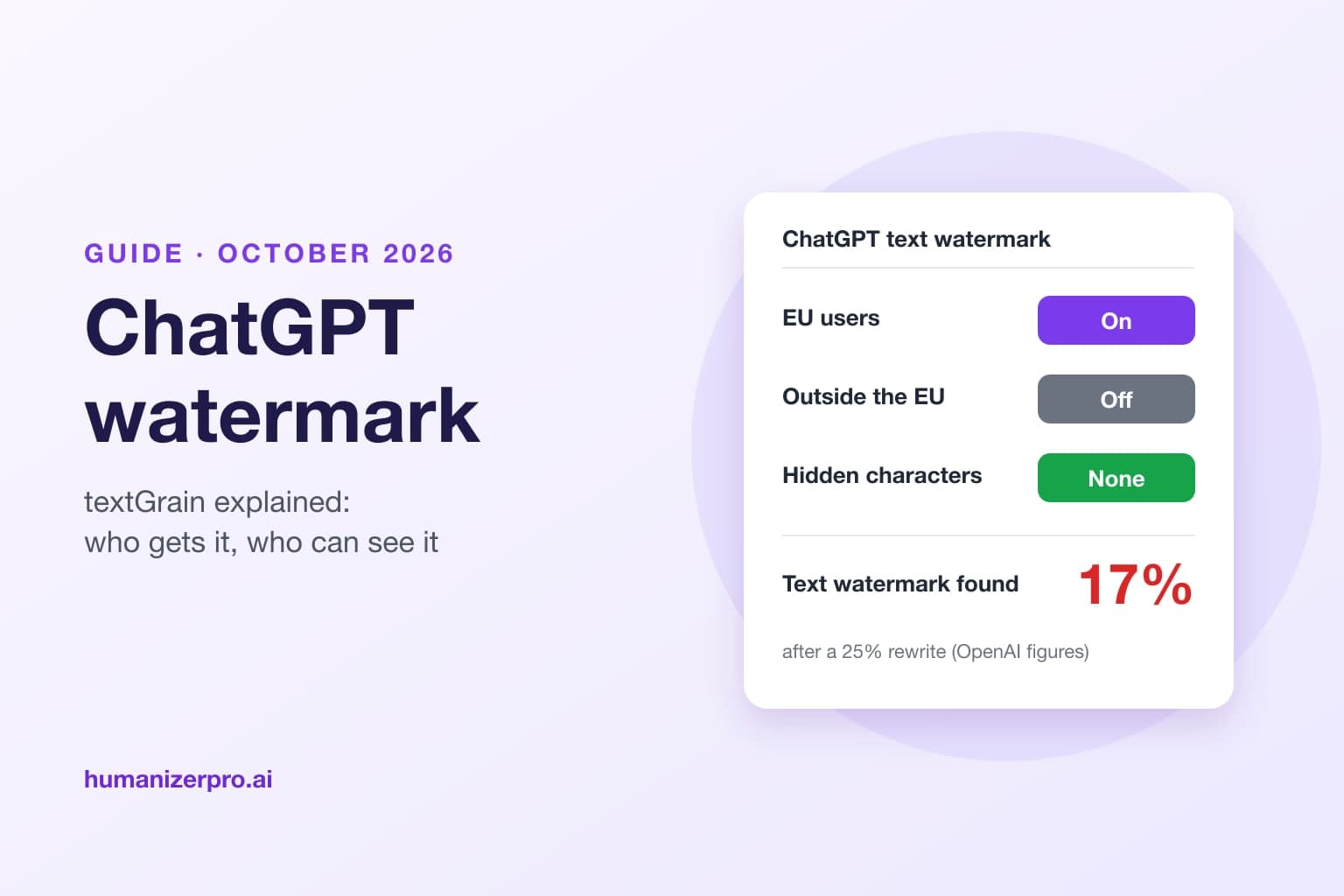
Yes, but at the moment, only in the EU. On October 5, 2026, OpenAI announced textGrain, an invisible watermark it's adding to ChatGPT and Codex text for users in the European Union, on every plan, to comply with the EU AI Act. The watermark isn't some hidden character or special symbol. It's a statistical pattern in the words ChatGPT chooses, and only a detector with OpenAI's secret key can spot it. Outside the EU, ChatGPT text doesn't have a watermark by default, and only approved researchers can use OpenAI's detector, so teachers and employers can't check for it.
Key takeaways
- ChatGPT and Codex text in the EU carries an invisible textGrain watermark, rolling out from October 2026 on all plans.
- Outside the EU, ChatGPT text isn't watermarked by default. API developers anywhere can turn it on for their projects.
- The watermark is a pattern in word choices. It adds no hidden characters, invisible spaces or special punctuation, and em dashes have nothing to do with it.
- Only approved research groups can use OpenAI's text detector. OpenAI says checking student work is outside the program.
- Editing weakens it fast: in OpenAI's tests, swapping 10% of words for synonyms cut detection from about 92% to 66%, and swapping 25% cut it to 17%.
- Google's Gemini has watermarked text with SynthID Text since 2024, and Anthropic watermarks text from new Claude models worldwide.
ChatGPT's watermark at a glance
| ChatGPT text watermark | |
|---|---|
| Name | textGrain |
| Announced | October 5, 2026 |
| Who gets it | ChatGPT and Codex users in the EU, all plans |
| Outside the EU | Off by default; API developers can opt in |
| What it is | A hidden pattern in word choices |
| Hidden characters | None |
| Who can detect it | Approved researchers only |
| Short answers | Texts under about 150 words don't have to be marked |
| Why | EU AI Act transparency rules |
What is textGrain?
textGrain is how OpenAI marks its text with a watermark. According to OpenAI's help page, it "subtly adjusts how the model randomly chooses between possible words or word pieces as it writes". Over a whole passage, those choices form a pattern that a detector can look for, "even after some edits".
Here's how it works. Whenever ChatGPT picks the next word, it chooses from several likely options, each with its own probability. textGrain makes a few tweaked sets of those probabilities, each leaning toward different words based on a secret key, and balances them so they still average out to the original. The key decides which set to use, and then the model picks a word at random in the usual way. Someone with the same key can later see if a text matches the pattern more often than chance would allow.
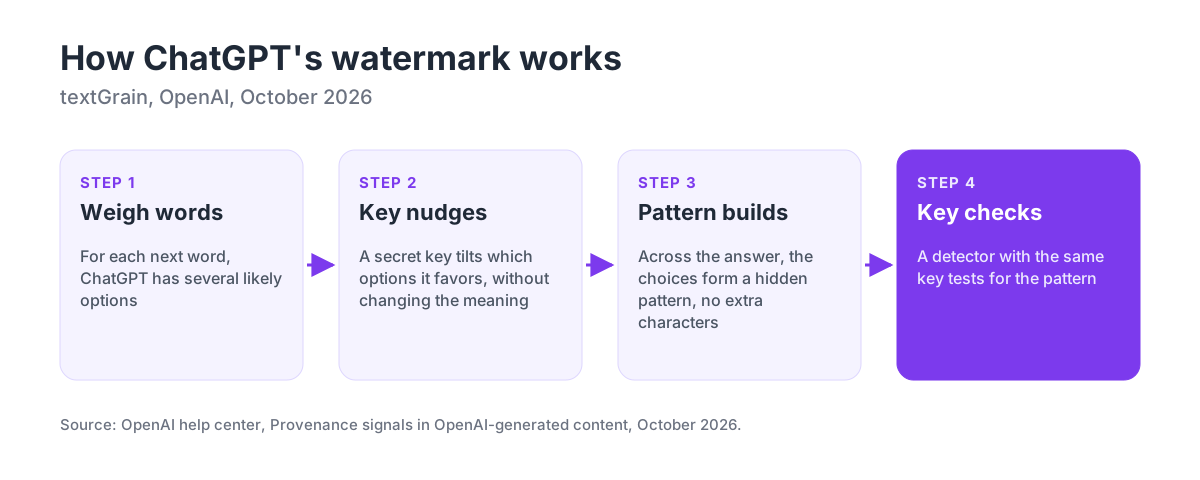
Since the pattern is part of the wording, it goes along with the text whenever you copy and paste it. OpenAI says the watermark doesn't reveal your identity, account or prompt, and that its testing found no drop in answer quality or speed.
Who gets the ChatGPT watermark?
OpenAI said it would start adding the watermark to "eligible ChatGPT and Codex text output in the European Union" on all plans in the weeks following October 5, 2026. It's not the default everywhere. TechCrunch reported that developers using OpenAI's API anywhere in the world can turn it on for certain models, but it stays off unless they choose to.
Some text is left out. The EU's Code of Practice doesn't require watermarks on outputs shorter than 200 tokens, around 150 words in English, or on code snippets. OpenAI also says that very factual answers, like a math result, don't give the model much room to change the wording, so the watermark might not appear there.
Does ChatGPT add hidden characters to its text?
No. OpenAI says text watermarking "does not insert hidden characters or add watermark-only tokens", and that copying and pasting "does not introduce hidden material". That dispels three common myths.
| Myth | Fact |
|---|---|
| ChatGPT hides invisible characters in its text as a watermark | textGrain uses word choices only. In April 2025, a startup called Rumi found narrow no-break spaces in some o3 and o4-mini answers, but OpenAI reportedly called them a quirk of training, not a watermark |
| Em dashes are ChatGPT's watermark | Em dashes are a style habit of many AI models, not a watermark, and plenty of people use them |
| Watermark "remover" tools clean ChatGPT text | Tools that delete hidden characters or swap punctuation don't touch textGrain, which lives in the words themselves |
Our Grubby AI review looked at one humanizer that sold "ChatGPT watermark" removal before any text watermark existed.
Can teachers detect the ChatGPT watermark?
No. OpenAI's text detector isn't available to the public. Only approved academic and research groups studying how well text watermarking works can get access, and OpenAI says academic integrity uses, "such as checking student work for AI use (e.g. in writing essays or theses)", are outside the program.
So when a teacher puts an essay into Turnitin or GPTZero, the software isn't picking up a watermark. These tools analyze writing style and estimate the probability that AI wrote the text, and they can get it wrong. Our guide to how accurate AI detectors are explains why, and our guide for people falsely accused of using AI covers what to do if it happens to you.
OpenAI also advises against putting too much stock in either the presence or the absence of the watermark. A detected watermark shows an OpenAI model "likely generated or processed the content", but it doesn't say how much a person wrote or edited. And "the absence of a detected watermark does not prove human authorship".
How reliable is the ChatGPT watermark?
It does a good job with long, unedited text, but it weakens fast after that. In OpenAI's tests, reported by BleepingComputer, the detector caught about 95% of 400-token answers to psychology questions and about 80% of 200-token answers, at a 1% false-positive rate. Math answers were harder. Language matters too: when OpenAI tested the watermark across the 24 official EU languages, detection went from 69.0% for Spanish down to 42.2% for Romanian, until it made the watermark stronger for the languages that didn't do as well.
Editing causes the most damage:
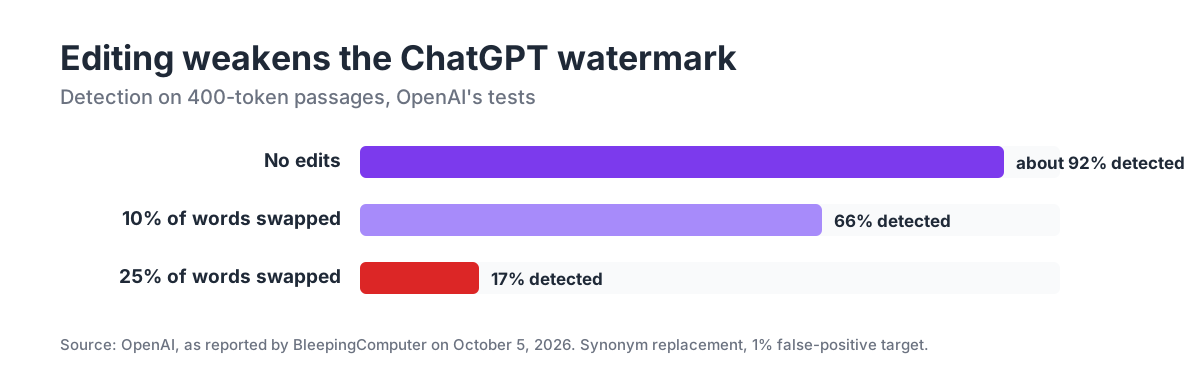
OpenAI's help page says the same thing: "substantial rewriting, paraphrasing, or translation can make detection less reliable". That's the case whether a person rewrites the text or uses a tool. HumanizerPRO (humanizerpro.ai), a free AI humanizer with a built-in AI detector, plagiarism checker and fact checker, turns AI drafts into natural English, and as with any thorough rewrite, it shifts the wording the watermark relies on. It still doesn't change who came up with the ideas. If your school or employer wants you to say whether you used AI, the lack of a watermark doesn't matter. Our guide to removing AI watermarks covers what's legal and what isn't.
ChatGPT vs Claude vs Gemini: which AI text is watermarked?
ChatGPT isn't the only chatbot that adds markers to its text. According to TechCrunch, Anthropic, Google, Meta, Microsoft and OpenAI have all committed to the EU's code of practice on AI-generated content, and Anthropic said in August 2026 that it would watermark Claude's text worldwide.
| Chatbot | Text watermark | Where | Since |
|---|---|---|---|
| ChatGPT and Codex | textGrain | EU only (API opt-in worldwide) | October 2026 |
| Claude | Invisible text watermark | Worldwide, for models released from August 2, 2026 | August 2026 |
| Gemini | SynthID Text | Gemini app and web | 2024 |
None of these companies has released a public text checker yet. Google's SynthID Detector checks images, video and audio, but not text.
Why OpenAI changed its mind
OpenAI developed a text watermark years before it released one. In 2024, the Wall Street Journal reported that OpenAI had a method that worked but decided not to release it. At the time, reports raised concerns that it might be unfair to people who don't speak English as their first language, and that users could just move to chatbots without a watermark. OpenAI said then that rewording could easily get around the method.
The law is what changed. The EU AI Act's transparency rules started on August 2, 2026, and require AI providers to mark generated content in a machine-readable way. Systems already on the market have until December 2, 2026 to comply. OpenAI connects textGrain directly to those rules, and says it plans to make textGrain open source.
What the ChatGPT watermark means for you
- Students in the EU: your ChatGPT text now carries a watermark, but your school can't check it with OpenAI's tool. Follow your school's AI rules either way.
- Writers and marketers: a watermark doesn't stop you from using AI-assisted text. If you publish AI text to inform the public on matters of public interest in the EU, the AI Act asks for disclosure unless a person reviewed it and takes editorial responsibility.
- Developers: if you use the OpenAI API, watermarking is off by default. You can turn it on per project in Settings, under Text provenance.
- Everyone else: outside the EU, ChatGPT text isn't watermarked by default for now.
Want to see how your text reads to a detector? Watermarks aside, most schools and sites still use pattern-based AI detectors. Check your text with HumanizerPRO's free AI detector, no sign-up needed.
FAQ
Does ChatGPT have a watermark?
Yes, in the EU. Since October 2026, OpenAI has been adding an invisible watermark called textGrain to ChatGPT and Codex text for EU users, whatever plan they're on. By default, ChatGPT text isn't watermarked outside the EU. ChatGPT images have their own SynthID watermark and Content Credentials everywhere.
Is ChatGPT's watermark in the US?
Not by default. As of October 2026, the textGrain text watermark is switched on only for ChatGPT and Codex users in the EU. Developers anywhere can turn it on for their own API projects.
Can you see the ChatGPT watermark?
No. It's a pattern in the way ChatGPT picks words. There are no hidden characters, zero-width spaces or special symbols, which means you can't see it, highlight it or find it with a character checker.
Can teachers or Turnitin detect the ChatGPT watermark?
No. OpenAI's text detector is only open to approved research organizations, and OpenAI says checking student work for AI use is outside the program. Turnitin and GPTZero rely on writing patterns to detect AI, not on watermarks.
Do em dashes mean ChatGPT wrote something?
No. AI often uses em dashes, but they're not a watermark, and plenty of people use them as well. The actual ChatGPT watermark is a hidden pattern in word choices that you can't see.
Does editing remove the ChatGPT watermark?
It makes it much weaker. In OpenAI's tests on 400-token passages, replacing 10% of the words with synonyms cut detection from about 92% to 66%, and replacing 25% cut it to 17%. Translating or heavily paraphrasing the text also makes detection less reliable.
Does the ChatGPT watermark identify me?
No. OpenAI says the watermark doesn't contain information about the user, organization or prompt. Finding a watermark just means an OpenAI model probably generated or processed the text.
Can I turn off the ChatGPT watermark?
Not in ChatGPT if you're in the EU, where it's added on every plan. Outside the EU it isn't turned on automatically, and API customers decide whether to enable it for their projects.

Kamran Khan
Kamran Khan is the founder of HumanizerPRO and a leading voice in the ethical use of AI-generated content. With years of hands-on experience in AI, SEO, and digital publishing, he built HumanizerPRO to help creators and professionals turn robotic AI text into clear, human-like writing that meets real-world standards.